

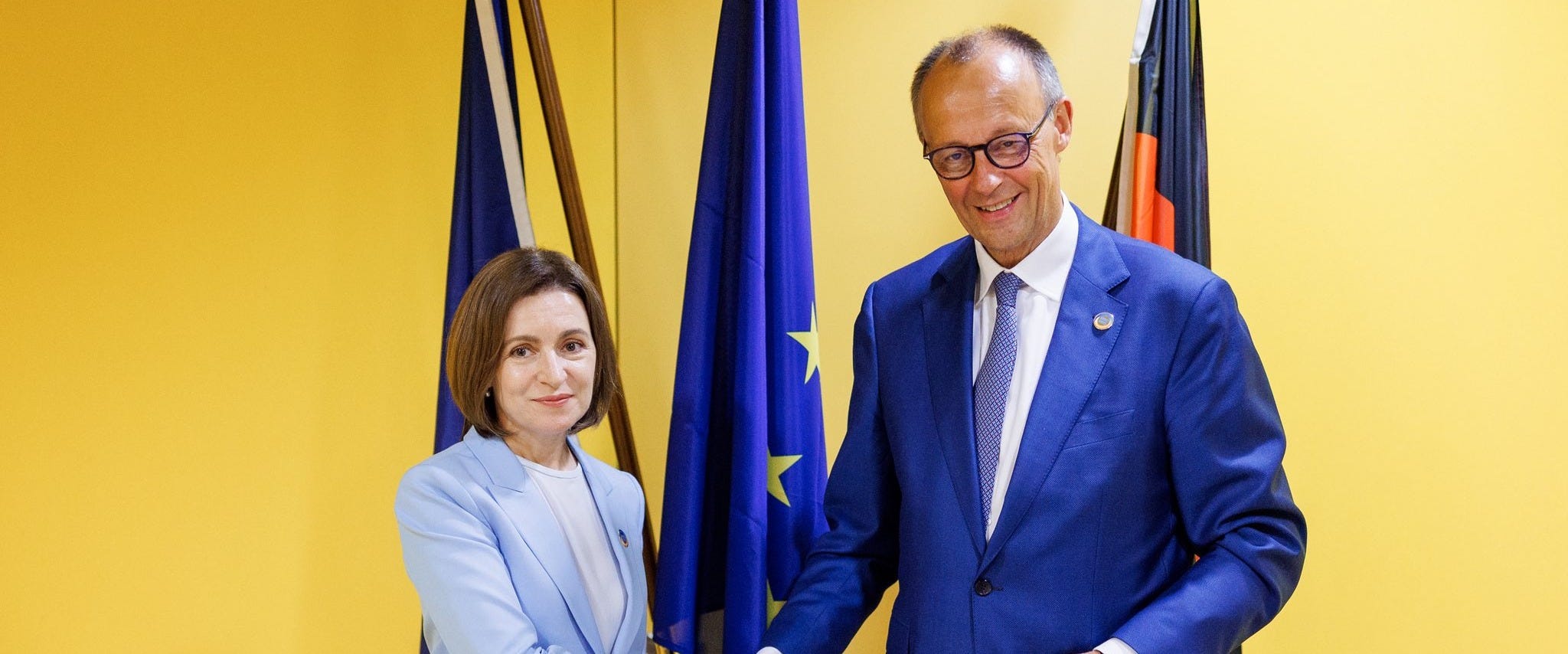
Despite an intense campaign of Russian meddling, including alleged vote-buying and a disinformation campaign, Moldovans chose Europe in their national election yesterday. The pro-EU Action and Solidarity (PAS) party led by President Maia Sandu won a surprising 50.1%, meaning it will keep its governing majority in parliament and will not have to form a coalition. The pro-Russian (and ironically named) Patriotic Electoral Bloc scored 24.2%.
“An example to us all”
The win isn’t without controversy however. The Moldovan government and judiciary aggressively countered the Russian interference ahead of the election, including by banning two pro-Russian political parties due to suspected illegal campaign financing from Moscow. Moldovan authorities conducted 250 raids on 22 September and detained more than 70 people allegedly linked to a Russia-backed plan to incite ‘mass riots’ after the election and destabilise the country. It also appears that one of the main bridges that would be used by Moldovan citizens living in the Russia-controlled breakaway territory of Transnistria to travel into the rest of Moldova to vote was blocked, though it’s not clear if this was by government forces or private citizens. Several other bridges across the Dniester River were closed for construction, and there are reports that people trying to cross the few crossing points available were subjected to lengthy searches and didn’t make it over in time to vote. The Transnistrian authorities are loudly complaining about that today, though it’s obvious to ask - if they say they are not part of Moldova, can they really insist that their residents be allowed to vote in what they say is a separate country?
The very different reactions today show how this election became part of a wider ideological battle. The European and American far right is calling the election a travesty, in the same way that they criticised Romania overturning the first round of their election result after a Russia-backed candidate unexpectedly won in strange circumstances. US Vice President JD Vance strongly criticised that decision at the Munich Security Conference in February. The Hungarian Conservative, a website linked to Prime Minister Viktor Orban’s ruling party, called yesterday’s result a “dirty election” that is part of the same censorious impulse that was seen in Romania.
But others have cheered Moldova for taking an aggressive and proactive approach to Russian meddling before the election, learning from the mistakes of Georgia and Romania who only tried to address the meddling after their elections. The stakes are simply too high to take the Russian meddling lying down. “Moldova is an example for us all,” said Romanian MEP Dan Barna today. “Citizens defeated a furious attack not with weapons, but with democracy, showing all of Europe the true power of the European dream.” “Moldova, you’ve done it again,” said EU Commission President Ursula von der Leyen. “No attempt to sow fear or division could break your resolve.”
As Europe faces existential crisis, Merz wants to talk about red tape
The election comes three days before a critical European summit in Copenhagen, a city which has recently been subjected to suspected Russian drone incursions which forced the airport to be closed. On the first day EU prime ministers and presidents will meet, and on the second day they will be joined by leaders of the wider European Political Community, which includes non-EU countries like Moldova, Turkey and the UK. As the leaders gather in a city besieged by Russian drones, talking about the existential threat posed to Europe by Russia to the East and America to the West, what is German Chancellor Friedrich Merz coming to the summit intent on discussing? There are too many EU forms to fill out. He is ready to squash EU ambitions for mutual defence and kill the idea of participating in the EU drone wall to protect the union’s eastern frontier. No no, he says, what the EU should be talking about right now is that it’s spending too much money and holding back business development.
EU bureaucracy is a tired and long-standing obsession which national leaders love to use to bash Brussels - especially as a way of distracting from their own mistakes as national leaders. If there was any doubt that Germany is failing to meet the moment here, the talking points of its chancellor should put it to rest.
“Leaders will meet in the context of the successive airspace violations by Russia in the EU’s eastern flank - these provocations are a challenge to the EU as a whole,” an official close to European Council President Antonio Costa told Politico yesterday. “This moment calls for accelerated, concrete progress in strengthening Europe’s common defence. In Copenhagen, the leaders’ discussion will centre around developing concrete capabilities and joint projects that will serve our common goals in the field of defense,” including the drone wall, they added.
But apparently Merz didn’t get the memo. “He is threatening to derail the Copenhagen summit with complaints about Europe’s economic woes,” Politico reports. “We must now put a stick in the wheels of this machine in Brussels so that this constant regulation from the European Union’s legislative machine comes to an end,” he told German business leaders from his conservative CDU/CSU party. He said he is bringing to the Copenhagen summit “a concrete list of demands to turn around Berlin’s sluggish growth.”
Germany’s economy is in deep deep trouble at the moment, and Merz is emulating the strategy of many national leaders before him by pretending it’s the EU’s fault. After years of being the engine of the EU’s economy, Germany has turned into an anchor dragging it down. It was the worst-performing major economy globally in 2023 with a 0.9% contraction, followed by further 0.5% contraction in 2024 leading to a recession. Several economists, business figures and other experts have expressed concern that Germany’s economy is now in a permanent crisis mode, with the Handelsblatt Research Institute declaring that Germany is now in its “greatest crisis in post-war history” after projecting a third consecutive year of recession in 2025.
But comparatively speaking, Germany’s economy is not a disaster. Yes, there is currently a slowdown compared to the “labour market miracle” period of 2005 to 2019. But the hysteria coming from German commentators right now is completely overblown, and seems out of touch at a time when the EU is facing an existential threat to its very existence. Russian warplanes are invading NATO airspace, and the German chancellor thinks the most urgent thing that needs discussion is red tape. It’s surreal.
Brussels’ Merz disappointment
When he was elected earlier this year, there were high hopes that Merz might be the hero to ride in on a white horse and save a leaderless Europe. Immediately after being elected on 23 February, Merz told German television that he is in contact with other European leaders about making Europe “independent” from America. “For me, the absolute priority will be to strengthen Europe as quickly as possible so that, step by step, we can really achieve independence from the USA,” he said. “I never thought I’d say that on a TV show.”
Germany's next chancellor finally admits America is a danger - but there's political calculation behind it

"This is no longer the America we used to know,” center-right candidate Friedrich Merz told a rally. But the abrupt U-turn toward Trump criticism is likely meant to draw contrast with far-right AfD.
But since then, he has completely backed down from this kind of talk. Saddled with the (at least perceived) German economic disaster, he has become nearly absent on the European stage. Just like Starmer and Macron, he has made two grovelling White House visits to Donald Trump showcasing his servility. Gone is Merz’s talk during the campaign of America being a threat. Now he is desperately trying to curry Trump’s favour and playing down the US president’s comments.
The first signs that Merz was in trouble domestically and might not have the political capital to lead Europe’s defence against the American threat came already in May, when he was shockingly rejected as chancellor in a first round vote. That had never happened before in the federal republic’s history. He was elected in a second vote, deeply wounded by presumed defections from centrist MPs.
Then in June, Merz led the charge in instructing President von der Leyen to do a “quick and dirty” surrender deal with Trump. French President Emmanuel Macron, who had been trying to galvanise leaders into making a robust defence against Trump’s extortion with retaliatory tariffs and an anti-coercion mechanism, realised the game was up when Merz commanded surrender and abandoned his efforts to give Europe a spine. President von der Leyen then dutifully travelled to Scotland at the end of July to sign the EU’s surrender.
While she has been left to take the heat for this continental-scale humiliation, the reality is that she was acting under the instruction of a majority of national EU leaders. Friedrich Merz was instrumental in that decision. If he had joined with Macron in pushing for the EU to defend its citizens, President von der Leyen would not have signed that deal. In that alternative universe, we may or may not be in a trade war with America right now. Given what we’ve seen with US-China negotiations, there is every reason to believe Trump would have backed off in the face of such devastating economic repercussions. If he didn’t, both Europe and America would be experiencing some pretty major economic pain right now in this alternative universe with a courageous Merz. But at least Europeans would still have their dignity.
But we don’t live in that alternative universe. The hyperventilation over the economy in Germany right now has meant that its chancellor has absolutely no appetite for risk. Though we were promised a bolder leader than Merz’s predecessor, the notoriously spineless Olaf Scholz, what we’ve ended up with is more of the same. Germans, it appears, are still incapable of leadership.
And so, as Russia’s drones hover around the Copenhagen summit and Donald Trump prepares his next salvo against the EU, Friedrich Merz is going to take up everyone’s time with some red tape ranting. We still have no leader on this continent with the political capital and strength to lead us at this time of unprecedented threat. The Copenhagen summit will be yet another lost opportunity, another display of inertia. European leaders would do well to look to Maia Sandu for inspiration right now, as she shows courage in the face of threats from imperial superpowers. It is a courage that is lacking right now in Western Europe - and particularly in Berlin.