


Today, at a press conference ahead of the NATO summit in The Hague, Secretary General Mark Rutte was asked a tough question by a journalist from Al Jazeera. “NATO’s position for more than three years has criticised Russia for breaching the rules-based international order by invading Ukraine,” he noted. “Doesn’t all of that seem very hypocritical given the US’s recent actions which are clearly dubious under international law?”
“I don’t agree with that assessment at all, not one syllable of what you just said - you have this completely wrong,” Rutte snapped back. His dismissal of the assessment directly contradicts at least two NATO leaders - Norwegian Prime Minister Jonas Gahr Støre and French President Emmanuel Macron who said today that the US bombings are in breach of international law. But these days, Rutte seems to represent only one NATO leader - the only one who counts. Not only did Rutte refuse to offer even the slightest criticism of the Trump regime’s unilateral launch of a war against Iran (for which it did not consult European allies), he went further and gave an implicit endorsement of the bombing campaign. Confronted afterwards with the Norwegian prime minister’s assessment and asked what he fears most about possible escalation, Rutte chose to respond: “My biggest fear is Iran having a nuclear weapon…that is why NATO has said Iran should not have a nuclear weapon.” He went on to insist that the US is not breaking international law with its strikes - directly contradicting multiple European NATO leaders in order to protect one American NATO leader.
As usual, Rutte spent a large portion of his press conference defending Donald Trump. But on the Iran War he is far from alone in Europe. UK Prime Minister’s Keir Starmer’s first reaction was to imply support. “We’ve long had concerns about the Iranian nuclear programme…the US has now taken action to alleviate that threat,” he said when asked if he supports the strikes. Asked if he’s prepared to offer UK military support for America’s war, he demurred. “There is a risk of escalation, and that’s why all our focus has been on deescalation,” he said, steadfastly avoiding the quesgtion. Friedrich Merz, the new German Chancellor, praised Israel’s bombing campaign against Iran last week saying “this is dirty work that Israel is doing for all of us.”
It will surprise no one that the vast majority of Europeans oppose this war, as do the vast majority of Americans (57% of Americans are opposed, compared to 27% at the outset of the Iraq War and 10% at the outset ofd the Afghanistan War). But just like with the Iraq War 20 years ago, it doesn’t matter what the European public thinks. It matters what one man thinks - the President of the United States. It is he who presides over the American military protectorate in Europe, and in such a situation European governments will never be fully free to develop their own foreign policy. We are seeing European governments repeat the exact same mistakes of the Iraq War, and this was uncomfortably on display today following a meeting of EU foreign ministers here in Brussels where they were unable to muster any kind of unified response to America launching yet another war in the Middle East.
In 2003, when the United States launched its ill-conceived invasion of Iraq, more than half of the EU’s current members joined in the ‘coalition of the willing’. Though many today in America have a distorted historical memory that Europe opposed the war, they in fact are thinking of just two governments: France and Germany. The European public was overwhelmingly against the war, but as you can see in the map below the public opinion in each country had almost no correlation to whether the government joined it. 90% of the population in Britain and Spain opposed the war, and yet both countries joined the war. Smaller percentages opposed the war in France and Germany, yet their governments refused to join (for which France in particular was viciously attacked in the US, where French fries were notoriously renamed “freedom fries” for a while).
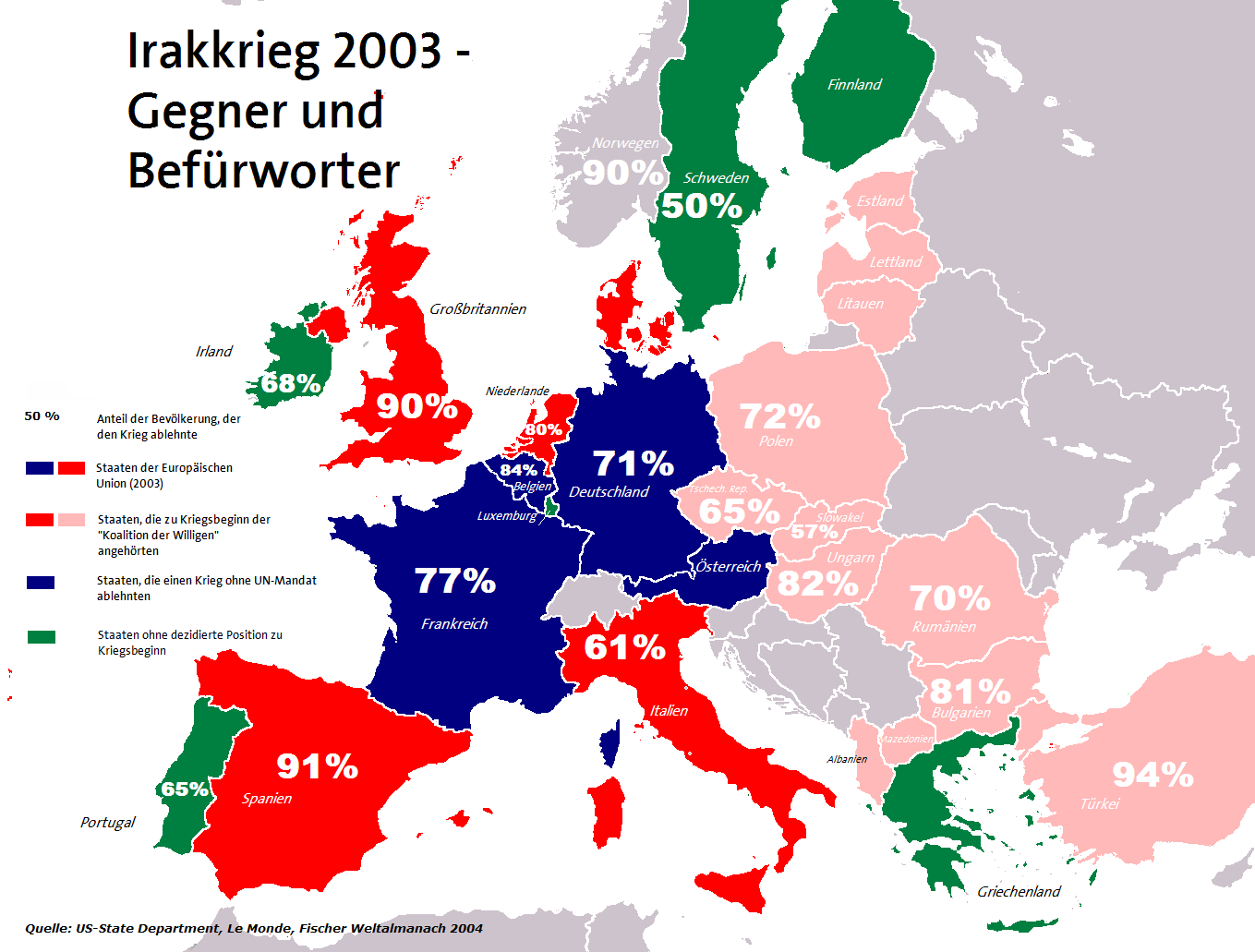
The Iraq War showcased the disunity and impotence of Europe. Washington was able to divide and conquer, with Defence Secretary Donald Rumsfeld famously dismissing the objectors as “old Europe”. If the European Union (and the accession countries scheduled to join the following year) had been able to settle on a common foreign policy position against the war, it probably wouldn’t have happened. But the EU didn’t. A sufficient number of European countries were bought off, giving President Bush political cover for launching the war because he was supported by most European countries, even if most didn’t send any troops in the end. On a continent that depends on the United States for its military, economic and cultural infrastructure, a majority of European governments felt compelled to do what Washington told them to do. Without their endorsement, it’s quite likely the Bush administration would have felt they didn’t have the political cover needed for the invasion even if they could of course have accomplished the invasion on their own.
The silence or endorsement from EU foreign ministers as they exited the Council building today was all the more embarrassing because the Europeans have been strung along for a month by reports that Trump was about to revive the JCPOA (rebranded with his own name rather than Obama’s) treaty that successfully got Iran to stop their nuclear program in 2015 but was then ripped up by Trump when he took office in 2017. If such reports were true, that was scuppered by Israel’s bombing campaign last week (an action Netanyahu reportedly did not coordinate with Trump because it was designed to pressure him into abandoning negotiations and join the war).
Even worse, the inconclusive discussions today forced off the agenda a planned move toward suspending the EU-Israel Cooperation Agreement. About half of EU governments had requested a review into whether Israel’s actions in Gaza violate Article 2 of that agreement, and article which makes the cooperation conditional on respect for human rights. The Commission’s review concluded that Israel had in fact violated the terms of the agreement, prompting the Israeli government to call the report “outrageous and indecent.” But though foreign ministers were expected to move toward suspending the cooperation agreement today in reaction to the report’s findings, the war Israel has launched against Iran meant that didn’t happen. Human rights campaigners are furious tonight.
“As global attention is focused on the Israel-Iran escalation, and recent U.S. strikes on Iranian facilities, Netanyahu’s government is pushing on with a war in Gaza that has so far killed over 54,000 Palestinians, led Gaza’s residents to the point of mass starvation if not famine, and is forcing them at gunpoint into barely a fifth of the strip’s already crowded area,” said Lisa Musiol, Head of EU Affairs, International Crisis Group. “Alarmed by these policies, many European leaders had started to consider steps to increase pressure on Netanjahu’s government and insisted that they won’t let attention on Gaza slip amidst the Israel-Iran conflict. Those intentions have gone up in smoke today.”
The NGOs are calling for EU prime ministers and presidents to vote to suspend the agreement at their European Council summit in Brussels on Thursday, but because of the war it’s now extremely unlikely that will happen. I’m hearing that several EU member states have refused to even have a sentence in the Council conclusions acknowledging that the Article 2 review happened. For many within and outside the EU, this all looks nothing short of obscene. “If the EU does not back its words with action then, it will be another huge blow to its credibility,” warned Musiol.
That is the big risk for the EU here. By falling into line and refusing to condemn the superpower on whom they are dependent, European governments will yet again take the blame for a war they did not start and actually (behind closed doors) opposed. How can anyone take EU leaders seriously when they condemn Russia when it violates international law but praise America when they do it? We are five month in with the Trump regime, this is not going to be the last violation of international law. Even if this current crisis does not escalate into a wider war that Europe is dragged into, what about the next time? If Europe doesn’t stand up for the basic principles of international law now, then when will it? The time to stand up for a free and sovereign Europe is now. Europeans had two decades following their humiliation with the Iraq and Afghanistan wars to develop a unified and strong foreign policy. As usual, inertia got the best of them. And so we are doomed to repeat the exact same humiliating patterns, and Europe’s leaders look set to fail their citizens yet again.
It will be a shameful moment for Europe’s leaders if they endorse this war, even as it escalates, simply out of fear of American retribution. And citizens should not forgive them if they do.