


It’s that time of year when journalists and pundits make their grand pronouncements about the year that was and the year to come. Few would disagree that for Europe, 2025 has been an annus horribilis. The election of Donald Trump has transformed Europe’s security situation overnight. To the East, Europe faces the possible surrender of Ukraine due to the US ending support, which will likely embolden Russia to prepare for an invasion of the European Union in the coming years. To the West, Europe faces a United States that has transformed from protector to aggressor, with Trump threatening to invade and annex Danish territory and the White House publishing a National Security Strategy that is openly seeking regime change in Europe.
As I outline in my new book The Owned Continent, Europe now finds itself in an incredibly vulnerable position. Decades of Atlanticist leadership has made Europeans culturally, economically and militarily dependent on the United States - the same United States that is now openly threatening Centrist governments, supporting far-right challengers and sanctioning European lawmakers if they pass laws the US doesn’t like. The Trump administration is seeking to turn America’s unspoken protectorate system in Europe into outright vassalage, and Europeans’ America addiction means our leaders can’t see any way to resist. And so our leaders have been bending over backwards to placate Trump over the past year.
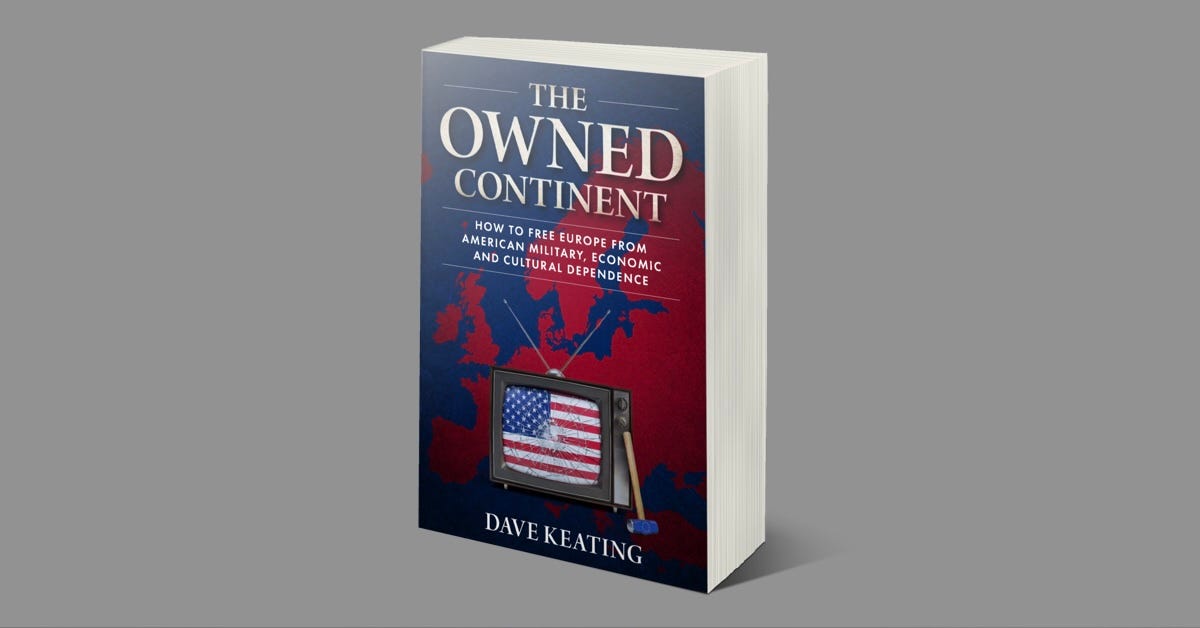
But my book doesn’t just diagnose the disease, it also prescribes the medicine: EU federalism. Long-time readers of this Substack and my former blog will know that this is not a new idea from me. I have been arguing for 20 years that EU federalism is the only way for Europe to be sovereign and independent. But as we start the year 2026 tomorrow, it’s important at this crucial moment that we make the case for why federalism is the solution to the crisis Europe now faces. These ideas may seem pie-in-the-sky and academic to many people. I’ve been hearing that for 20 years. But Europeans need to think about what the alternative is.
What will be the situation on this continent one year from now if things don’t urgently change? We face the very real possibility of US-supported far-right parties seizing power in snap early elections in 2026 in Europe’s three largest countries: Germany, France and the UK. We face the prospect of Europe being divided into two spheres of influence between Moscow and Washington, reminiscent of a bygone era. And we face the prospect of MAGA-aligned puppet regimes taking power across Europe, doing whatever Washington asks them to do.
Fearing the wolf, only to be eaten by the shepherd

For 75 years Europe has put itself under the protection of America due to a fear of Russia. But Trump's mooted Greenland invasion makes it clear Europe has been blind to the threat from its West.
When I talk to Europeans about federalism I often use an image from American history to illustrate the choice they face. It’s a political cartoon made by Benjamin Franklin originally during the French and Indian War in 1754, when most people would have assumed that were the colonies to secede they would have become individual countries. It is in fact the earliest known pictorial representation of united states. It was based on a superstition that if a snake was cut in pieces and the pieces were put together before sunset, the snake would return to life. The cartoon appeared alongside Franklin’s editorial about the “disunited state” of the colonies in which he stressed the importance of unity in the face of their shared enemies (at that moment, France). Twenty years later, that shared enemy became Great Britain and the cartoon was used during the Revolutionary War as a way to urge the states to stay together. Following independence, it was used to argue against the loose confederal government of the first iteration of the United States (1776-1789), and eventually convinced Americans to convert the American confederation into a federation, the United States of America.
That first confederal government of the United States closely resembles what the European Union is today. Though it is politically controversial to say so, among academics it is universally accepted that the EU today is a confederation, while some say it is already in many ways a full federation. European federalists, as a political movement, want to go all the way - to create a federal union that would work much the same as the United States, but with key differences. What that would look like has been outlined by the Young European Federalists movement in the chart below, showing the EU as it is on the left and the EU as they would like it to be on the right.

To drive home the point, I friend of mine made the above image replacing the US states with EU member states. Many Europeans may not like the idea of federalism. There are plenty of people who think that sovereignty only comes in the form of the European nation-states that were created in Europe in the 19th century. The “EUSSR” super state boogeyman that people conjure up gives the impression of a power-hungry Brussels which wants to subsume national identities in order to amass power for power’s sake. And as Elon Musk has weaponised X over the past two weeks following the Commission’s fine against him, the platform has been flooded with images vilifying the EU. But there has also been a counter-movement which, though it is shadow-banned on X, is creating powerful images to make Europeans understand the choice they face. For instance, this image below has been circulating on BlueSky and it expertly sums up the choice that Europeans now face. There is no sovereignty in nation-state independence. The sovereignty presented by people like Nigel Farage is really American vassalage. Many Europeans are tired of that vassalage. And that is why so many young people are sharing European federalist iconography lately, as detailed in this excellent Politico article earlier this month.
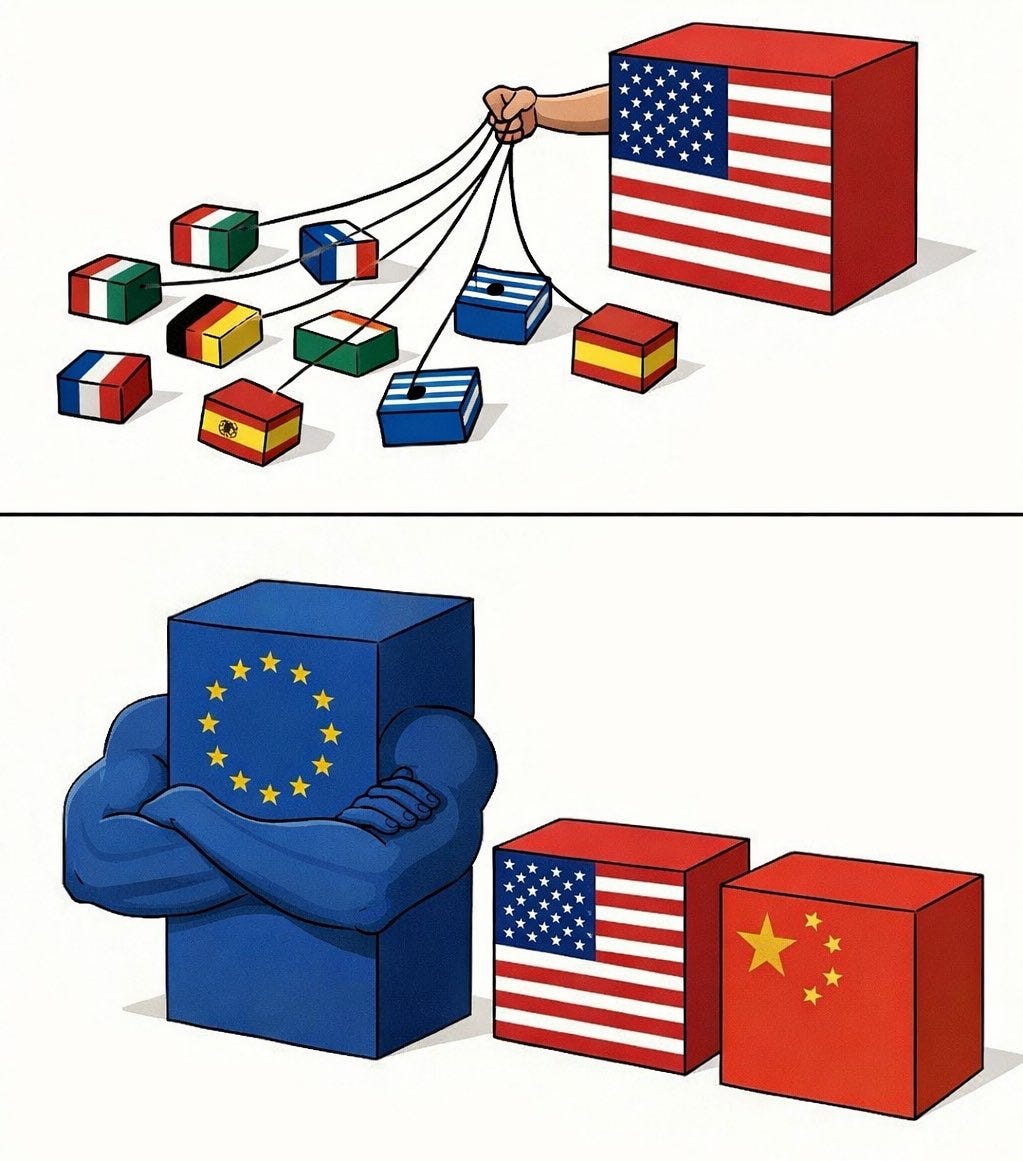
European national sovereignty is an illusion, and it has been for 80 years. Whether you were East or West of the Iron Curtain, a superpower was calling the shots. The vassalage may have been more obvious in the East, but it was also pernicious in the West - and that dominance simply spread Westward after 1989.
For many years, Europe’s Atlanticist leaders hid this truth from their citizens. They pretended the US military presence in Europe was smaller than it was. They presented the US as an ally rather than as a protector. And they made Europeans think that the economic infrastructure they use on a daily basis was sovereign when in fact it was American. But this year’s surrenders by European leaders to Trump have made the truth impossible to avoid. We’ve been told this surrender was impossible to avoid because of America’s power over this continent. The illusion of European national sovereignty has crumbled before our eyes.
In 2026, it’s time to get real. Europeans have two choices. They can accept the “daddy diplomacy” that their leaders have been pursuing with Trump over the past year, committing to be vassal states of America, or they can dare to reimagine what Europe is.