

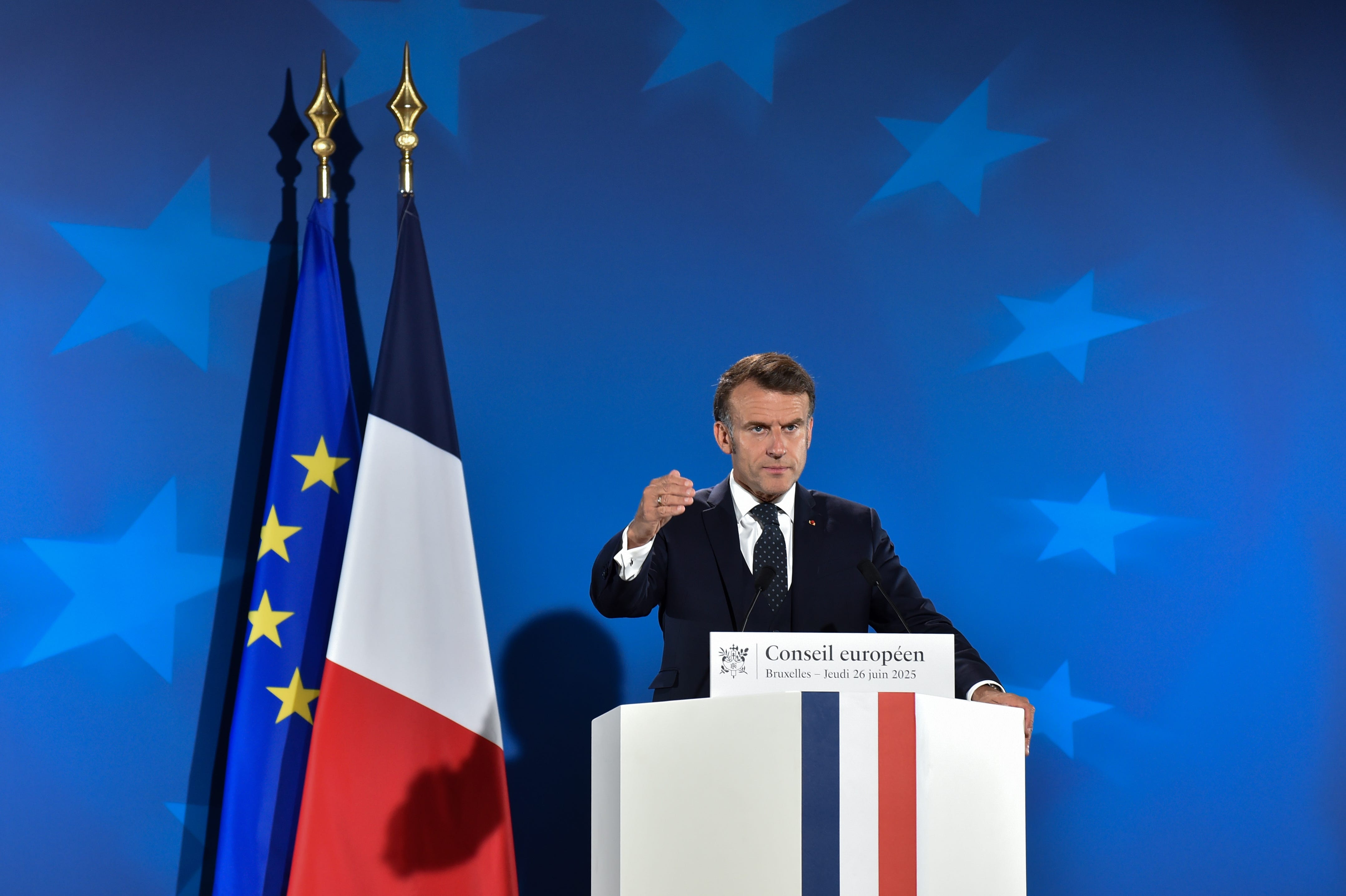
By the end of today, we’re supposed to have a new French government presented by President Emmanuel Macron. It will be his sixth prime minister since he was re-elected in 2022 - an unprecedented situation. This person will replace Sébastien Lecornu, whose government lasted just 14 hours. Ever since Macron made the disastrous decision to call a national parliamentary election following the poor showing of his centrists in the European Parliament election last year, the French parliament has been split evenly into far right, centrist and leftist blocs. No sustainable majority can be found.
Macron’s intent was to call the French public’s bluff, betting that though they had voted in the plurality (31% compared to Macron’s 13%) for the far right in the EU election to send a message, they would not be willing to do so in a national election. He was wrong. Though the far right didn’t outright win that national election as some had expected, they gained a large amount of seats. That, along with gains for the far left, has rendered the parliament ungovernable. Like in the US, France has a presidential system which means Macron is elected separately from the parliament. Now, he is facing calls from far right leader Marine Le Pen not only to hold a new parliamentary election, but also to resign and call a snap presidential election - which he doesn’t have to do until 2027.
“The ‘easiest’ option would be for Emmanuel Macron to simply nominate a new Prime Minister, either from the Socle Commun or from the left, but the simple reality is that this may just not be possible anymore,” wrote my partner in crime Julien Hoez in his French Dispatch Substack on Monday. “There was a period of time when he announced that it was necessary to reach out to the left, and he could have nominated someone like Olivier Faure, the first secretary of the Parti Socialist. But currently he’s not even sure to accept this anymore. Likewise, nominating someone from the centre will simply lead to the same result, and if you nominate someone from the far-right, then you not only give them a platform to spread their nonsense misinformation (hi Trump, Boris, etc), but when they eventually get censured by two-thirds of the Assemblée, and they will be censured, then you also give them a victim narrative to carry into the next elections.”

Macron’s other option is to dissolve the parliament and call a new legislative election (for the parliament, not himself). But the expectation is that such an election would yield the exact same hung parliament result as the last one did, and nothing would change.
European implications
Time is of the essence because the market vultures are circling Paris. The French government has until Monday to present its 2026 budget if there is any hope of approving it before the 31 December deadline. And there needs to be a prime minister in place to do that. If the eurozone’s second-largest economy can’t pay its bills, we could see a repeat of the eurozone crisis of 15 years ago.
France borrowed a lot of money during the pandemic and now has €3.4 trillion worth of debt, with a budget deficit of 5.4% of GDP this year. But every attempt to cut spending by the governments in place since 2022 has been defeated, prompting each government to resign. EU rules put in place after the Eurozone crisis say budget deficits can’t exceed 3% of GDP, and the Commission has put France under an excessive deficit procedure. France has to get down to this level by 2029. But if the 2026 budget doesn’t make cuts, that timeline will be impossible to meet. The worst case is that France might need an EU bailout if the markets turn on the country - a scenario which at this point is still unlikely but possible.
Aside from the economic implications, there are also geopolitical consequences for this chaos. “Emmanuel Macron has been a mixed blessing for the EU: while he stood out for his almost unique capacity to articulate a long-term vision for a more autonomous and integrated Europe, his poor political instincts—culminating in the ill-fated decision to call snap elections in June 2024—have eroded his domestic authority and fuelled opposition to the pro-EU agenda he embodies,” argues Riccardo Alcaro, head of the Global Actors Program at the Italian Institute for International Affairs. “A politically paralyzed France, or one led by a sovereigntist government from the nationalist right, would likely hinder progress on key European priorities, from sustained support for Ukraine to implementing the Draghi report on competitiveness.”
“It seems unlikely that Paris, stuck in the midst of its current institutional chaos, can preserve enough credibility and influence to sustain its diplomatic ambitions and those of the union,” worries Pierre Vimont, a senior fellow with Carnegie Europe. “Naturally, Paris and Brussels will pretend otherwise, but intertwined interests between the two make both rise and fall together. France has traditionally preempted the role of natural think tanker for the union (think of strategic autonomy). And all its European partners readily accepted that informal division of labor whether they liked French concepts or not.”
“In Paris’s absence it is difficult to imagine any other European nation ready to take over, if only for lack of the two important components of the country’s diplomatic sway: its nuclear deterrence and permanent seat at the UN Security Council. One can only hope therefore, for the sake of the EU, that French politicians rapidly regain some dose of political wisdom.”
A leaderless Europe
Europe has a leadership vacuum at its most dangerous moment since World War II. The lame duck French president will inevitably be too distracted with domestic turmoil to lead at European level. The German chancellor does not have the will or the political capital to lead Europe toward independence despite his lip service to the topic. The backbone of the feckless British prime minister has been MIA as he has bowed to Trump and signed surrender deals. He is now the most unpopular British prime minister in recorded history, which is astonishing considering he only took office last year. There is talk within the Labour Party of replacing him. The most powerful leader in the EU at the moment seems to be Giorgia Meloni from the far-right Brothers of Italy party. But in her quest for centrist optics she actually hasn’t done much of anything at European or national level, and she has not shown any interest in making Europe independent of the Trump regime. The only EU leader who has shown backbone in this respect is Spanish Prime Minister Pedro Sanchez. But Spain is unfortunately an often overlooked country without significant political capital in Brussels.
If we had a strong Commission President at this moment, that person would be stepping in to fill the vacuum. But as I wrote back in January, President Ursula von der Leyen’s character always made her an unlikely candidate to be the hero Europe needs right now. She was appointed precisely because she is not someone that would challenge the authority of national leaders. One could imagine what a President Jacques Delors (or a Commission President Emmanuel Macron) would be doing in this situation. He would take the case to the European people that the EU needs to stand strong against American bullying and hit back with counter-sanctions and the trade coercion instrument. He would go directly to national MPs and the European media and say, “I’m going to march into the European Council and tell them they must not surrender to Trump’s extortion. And if they insist that we do, they should be held accountable by you.” That’s called using the bully pulpit. Maybe he would even refuse to sign a surrender deal and dare the leaders to fire him and explain to their citizens that they did so because they want to give in to Trump.
Is there any hope? I don’t know. Things are not looking good right now. For the first time ever the far right is polling in first place in Europe’s three largest countries: France, Germany and Italy. They are already in power in the fourth largest country, Italy. Czechs have just put the far right in power in Czechia, giving Le Pen’s Patriots for Europe group a second seat in the European Council along with Orban. Trump’s far-right European allies are poised to take power thanks to the support they are receiving from Washington. The first major country to succumb to MAGA’s regime change efforts could be France. And if France falls, it’s unlikely to be the last.
America is pursuing regime change in Europe

The far-right candidate won yesterday's presidential election in Poland, thanks at least in part to help from the Trump regime. Centrist EU governments need to realise America wants them out.