

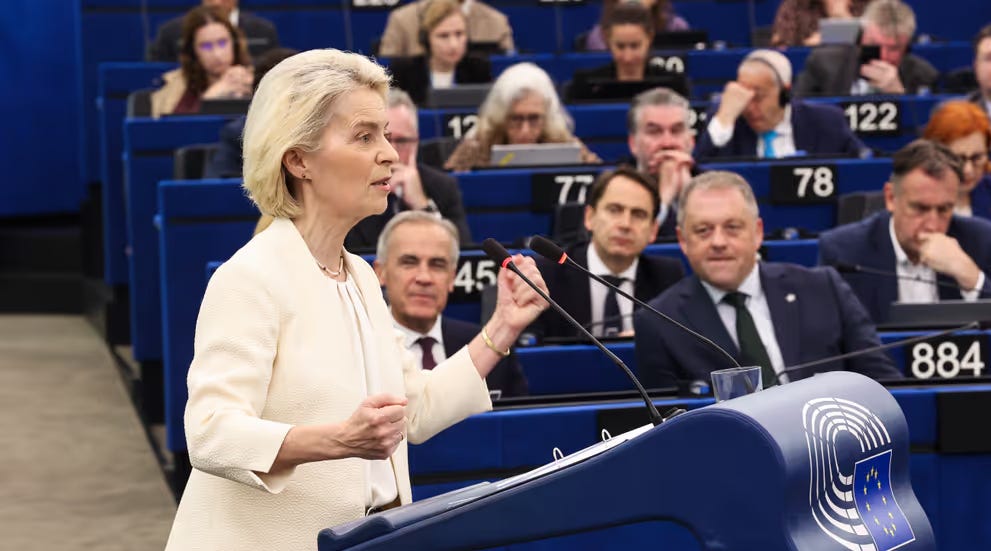
“Thank you very much for your patience.”
That was the rather uninspiring (and unscripted) line the EU president ended her State of the Union speech to parliament with this morning. And after seven of these annual speeches from President Ursula von der Leyen, which have contained grand words without serious attempts to accomplish them, you can understand why MEPs may have been feeling impatient. Once again, hats off to the Commission speechwriters – if only you were working with a leader who was willing to lead in accomplishing the words you put on paper for her.
There were several significant initiatives announced this morning. As expected, the Commission will propose an EU KIDS Act banning children in the EU under 13 from using social media and restricting it for 13-15 year olds. Less expected was the announcement that the Commission will spearhead the launch of a European Security Council, an idea championed by EU Defence Commissioner Kubilius which I’ve written about before. This would not be an EU body, so that it can include the UK and Norway. But notably, von der Leyen listed a third, non-European country that could participate: Canada. This would essentially make it NATO minus the US and Turkey. Canadian Prime Minister Mark Carney was in the audience for the state of the union, and he’ll be making his own speech to the Parliament tomorrow. Von der leyen announced she is “opening the door”for Canada to become the EU’s first “associate member”. But as I wrote yesterday, this is more of a PR exercise than an actual policy proposal – she offered no details on what this would mean.
I’ll go into more detail on these policy proposals below, but first it needs to be said that this speech was disappointing. In last year’s State of the Union von der Leyen declared it to be “Europe’s independence moment” – an idea she was poorly suited to be the messenger for considering she had just given into Donald Trump’s extortion by signing a surrender deal on his golf course a month earlier. Responding to that speech last year, centre-left S&D group leader Iratxe Garcia Perez blasted the president’s hypocrisy in calling for Europe to have courage and fight when she herself showed no courage with Trump. "You went to Scotland to bury Europe's strategic autonomy under a golf course,” she told her. In the year that has passed since, what exactly has von der Leyen done to deliver Europe’s “independence moment”? Politico did an analysis, and it’s not pretty.
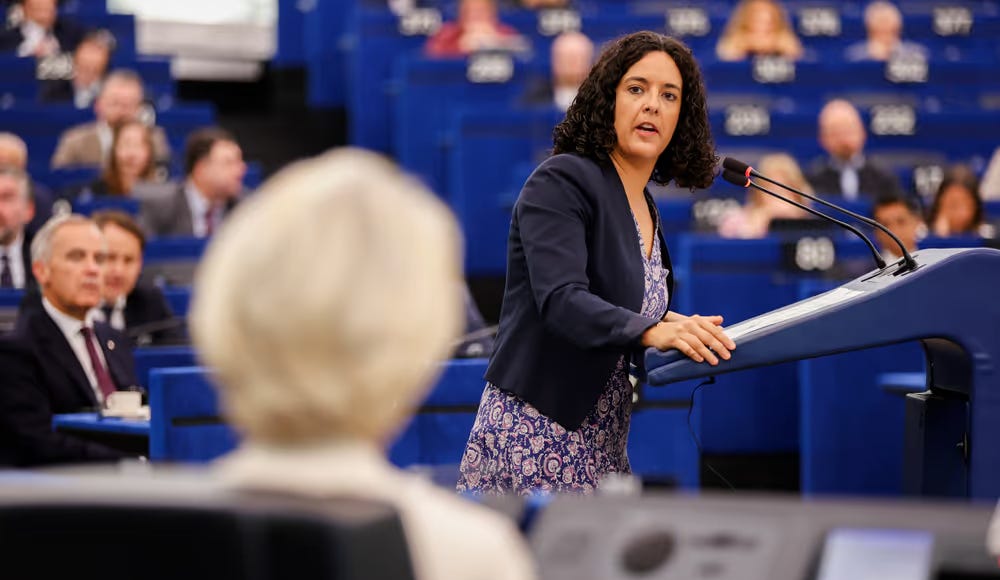
This year Garcia Perez went easier on the centre-right president, but far-left leader Manon Aubry did not. “Where were you when Trump was threatening Canada and Greenland? I guess you were signing a free trade agreement with Donald Trump,” she said to the president in her rebuttal this morning. “You hide behind a divided Europe but the problem is your inaction. Basically you’ve been talking to yourself, so I’m going to talk to the people of Europe: Be resolved not to continue in servitude.”
The problem, as Alberto Alemanno pointed out in his column today, is that once again this speech did not seem to match the moment: “This State of the Union produced a familiar feeling: déjà vu, well-intentioned and naïve, as only we Europeans can be. It offered incremental progress where the moment demands a quantum leap.”
“On security and political integration, Europe still hesitates to cross the Rubicon. A European Security Council, an Emergency Security Protocol and another strategic instrument may all be useful. But they skip the harder questions of who decides, by what majority, with which democratic mandate, and who is ultimately prepared to act?”
Most frustratingly, the EU president still refused to criticise the US by name – a strategy she has been employing for two years where she names the US when it’s something positive, but makes only vague references when it’s something negative. The references are becoming more and more pointed, but they remain sheathed. While she directly named China and Russia (the latter over and over) as threats to the EU, the words United States did not emerge once from her lips in this speech. “We stood up for Greenland when it was threatened,” she said, without naming the country threatening it. The claim itself is misleading, as she never led an EU response to protect Greenland but left it to a few national governments to send some troops there, two of which are not even in the EU. She asserted the EU’s right to make its own laws regarding big tech, without mentioning the government that is threatening the EU with consequences if they do that. "A battle of narratives is seeking to weaken confidence in Europe, to paralyse our democracies,” she said, as usual blaming Russia without mentioning that the narrative war is coming far more effectively from the US government.
Von der Leyen’s defenders will say she needs to be diplomatic, that she would put Europeans at risk by attracting Trump’s attention with a specific US reference. Indeed, her entire MO seems to be trying to escape Trump’s notice. But it is a painful contrast with the Canadian prime minister who was sitting in the audience this morning. He has directly named the United States as a threat to Canada and prepared his citizens for the enormous change and struggle that will come with disentangling themselves from a country on which they are dependent. Von der Leyen, and most of our national European leaders, won’t even directly acknowledge the dependence.
“Von der Leyen should be delivering a positive message, not a negative one,” I hear people reply. But Carney has shown that the two are not mutually exclusive. As I write in my book The Owned Continent, first you have to speak openly and honestly about the dependence on America and the threat the US now poses. Then you have to outline the steps to achieve independence. Like an alcoholic, the first step is admitting you have a problem. You need the first step before the second, otherwise you’re not telling citizens what the point of European soveriegnty is. Europeans are terrified right now of the US government’s erratic and aggressive moves. Our European leaders are saying we need to be more independent but they refuse to say why.
Unlike Carney, they will not call out the threat that makes this independence necessary. Continually conjuring up the spectre of a Russian invasion is not enough. Most Europeans do not believe Russia will invade the EU, and Europe is not dependent on Russia. But Europe is enormously dependent on the United States, which makes the threat from Washington much more dangerous than that from Moscow or Beijing. As Alemanno notes, it is naive to think you can inspire Europeans to action, to seeing the need for a united and strong Europe, while avoiding telling them the dangers and the stakes.
It is a sad reflection of the current leadership vacuum in Europe that MEPs will have to wait until tomorrow for the possibility of an inspirational speech. But that is exactly what they’re doing today. Europe apparently needs to import its inspiration. “Prime Minister Carney, you showed what should be done vis-a-vis Mr Trump: refuse to compromise, retaliate, protect your interests, speak the language of power,” Valerie Hayer, the leader of the liberal Renew Europe group (which includes Emmanuel macron and Rob Jetten), said in her state of the union response. “As you’re fully aware, Trump, Putin and Xi Jinping understand only one thing: the language of power. Every time we’ve played by the old rules, we lost.”
“I have a message to pro Europeans: we need a pro-European radicalism – we need more Europe and we need it more quickly,” she added. “I don’t want to be ashamed of Europe as I was a year ago [after the surrender deal].”
It wasn’t just the US that von der Leyen refused to criticise. She also would not push back against national EU governments acting against the European interest. She spoke of the Ceuta crisis and, not very convincingly, claimed that Europe is in solidarity with Spain. She did not dare to criticise Italy’s illegal and political Schengen suspension with Spain, which was just renewed for the third time, for fear of alienating her ally Giorgia Meloni. Regarding the current deregulation fever, she vaguely criticised gold plating by national governments without ever explaining what that means – missing an opportunity to explain to citizens that the so-called “EU bureaucracy” more often comes from national governments than from Brussels because of the incorrect way they’re applying EU laws. She feigned frustration with national governments for blocking action against violent Israeli settlers in the West bank, but refused to name the countries blocking that action (including her own). In fact the only national government she dared criticise was the one that was just voted out of power, heralding the 12 April election that unseated Viktor Orban as “the day the Hungarian people took their future into their hands, choosing democracy and choosing Europe.” What a profile in courage.
The policy proposals
Nevertheless, there were some concrete policy proposals in this speech that will have significant implications. The proposal for a European Security Council will be greeted with great trepidation by traditional Atlanticists on this continent and will be immediately lobbied against by NATO Secretary General Mark Rutte. In March I attended a speech by EU Defence Commissioner Kubilius outlining what that would look like, which I wrote about here. The key question is whether this would be a useless talking shop or a real way for Europe to exercise command and control for independent military action without the United States.
Von der Leyen did not offer any details about what this Council would be other than listing possible members (notably including Canada but not the United States). But I noted with great interest that in his state of the union response this morning, Manfred Weber – who leads von der Leyen’s centre-right European Peoples party in the parliament – brought up the fact that the European Defence Community still sits unratified since it put on ice by the French parliament in 1952. That community would have the capacity for command and control. That suggests there is thinking within the EPP, which has run the EU for the past two decades, that this Council could become something with actual coordination ability. But Rutte will do everything in his power to prevent that from happening, arguing that it will undermine NATO which he says is the only option for European security.
The kids social media ban is a significant proposal that will be fiercely opposed by American big tech and the US government. And that will be the big test of whether President von der Leyen means it when she says the EU makes its own laws. It is awkward timing that the rotating presidency of the EU Council is currently held by Ireland, a country whose economy is dominated by American big tech, companies which can thus exercise a great deal of pressure on the Irish government. But by the time this proposal comes to the Council for legislating, the presidency will have passed to Lithuania.
When it comes to this supposed “associate membership” of Canada to the European Union, I outlined yesterday why this is relatively meaningless (no such category exists, if it was created it would require treaty change, and EEA membership is not practical for Canada which would never accept having to follow laws made across an ocean that it doesn’t have a vote in). But if the “associate member” ruse provides an umbrella framework for concrete security and trade partnerships, then I have no problem with giving it that informal name.
There are plenty of opportunities for the EU and Canada to form a defensive alliance to coordinate economically and militarily to defend themselves from the United States. Canada has already been included in the EU’s SAFE instrument designed to lessen dependence on US arms manufacturers, and its inclusion in a future European Security Council could further provide more capacity to at minimum defend themselves without the US and at maximum defend themselves from the US. Von der Leyen’s line today that this alliance is "not against anyone else," may be deemed to be a necessary diplomatic cover, but everyone can see that the alliance is designed as protection from US abandonment or aggression. Nevertheless, this idea is likely to be seen as provocation by the White House. Brussels should not back away from that confrontation in the coming weeks and months. The EU needs to stand firmly behind Canada in a more robust way than it has so far.
Von der Leyen also talked about climate change and artificial intelligence as the two “tipping points of our time,” though she did not offer any concrete new ways to control them in this speech. “Europe is warming at double the global rate,” she warned, referencing this summer’s wildfires. “Of course, the transition is complex. And we will need to adjust and learn along the way,” – a reference to her omnibus proposals which are right now gutting the EU climate legislation passed during her first term that the president professes to care so much about. She said she will put forward a European Heatwave Plan to establish early-warning systems and more EU-level coordination before next summer, though this would deal with the effects of climate change rather than the causes.
She described herself as an “AI optimist”, trying to rebuff the US government’s “luddite” accusations against those who want to regulate it. But she warned AI “will soon be in the hands of adversaries who see the world very differently to us.” She tried to strike a balance between encouraging AI innovation in Europe while also regulating its development. But in the end she managed to say nothing of substance on either front.
“Her determination to escape toxic dependencies was welcome, yet the proposed answer was the traditional European inventory of packages, frameworks, funds and alliances,” noted Alemanno today. “This is no time for bombastic announcements that inevitably unmask modest financial and political capital means. Most striking of all was the silence on how the Union will pay for its ambitions. There were no references to the ongoing MFF negotiations, to significant new own resources, to common borrowing, or to fiscal capacity commensurate with the promises. Essentially, only the recurring hope that Europe’s fragmented private savings will somehow mobilise themselves.”
As much as she keeps attempting rhetorical flourish, it is impossible to escape the conclusion that Ursula von der Leyen is the wrong woman for this moment. She managed the Covid crisis well, but national leaders’ decision to re-appoint her for a second term in 2024 was a mistake that reflects Europe’s lack of vision at this moment. She is a symptom of this continent’s malaise. As each state of the union passes, this becomes more and more clear. Not only does she not have the courage to take on Donald Trump, she also doesn’t have the courage to take on national EU governments who are hurting Europe’s ability to be independent. A stronger leader would use the presidency’s bully pulpit to pressure national governments to do the right thing. She has proven herself incapable of doing so. But unless something dramatic happens, we’re stuck with her for the next three years. So we’ll have to make the best of it.
