


One of the most incredible things about the transatlantic alliance’s collapse over the past week has been seeing Europe’s lifelong Atlanticists suddenly preach European sovereignty with the zeal of the converted. The fever even seems to be breaking for the fiercely Atlanticist British press, for years behaving as if the UK is an American island just off the coast of Maine but now suddenly discovering themselves as European.
The Economist had a truly shocking leader on Tuesday warning that Europe must urgently prepare to be “abandoned or extorted” by "an increasingly hostile America.” Germany’s incoming Chancellor Friedrich Merz, who was so Atlanticist that he used to be chairman of the Atlantic Bridge think tank, shocked the country on election night two weeks ago when he announced, “we must achieve independence from the USA” and warned that NATO may not exist any more in just a few months’ time. I was particularly intrigued by the dynamic on The News Agents podcast, hosted by liberated former BBC journalists Emily Maitlis, Jon Sopel and Lewis Goodall, over the past two months. Maitlis and Goodall seemed to wake up to the new American reality much earlier than their cohost and tried in vain to convince the staunchly Atlanticist Sopel that America had fundamentally changed and there was no going back. Sopel, who spent much of his career as a BBC correspondent infatuated by America, simply couldn’t accept what they were saying. But then he seemed to have a Road to Damascus moment on Tuesday’s podcast when he was suddenly speaking with the zeal of the converted. "There is a sense that America wants Europe to fail, that America sees the world in three blocs now: three strongmen, Putin, Trump & Xi,” he concluded. "If that comes to pass, then what happens to Europe? Well, we're Russia's backyard. Just as Taiwan, South Korea and Japan are China's backyard. Look at how America is telling Canada they're the 51st state, and if you want to avoid tariffs you need to become part of the USA. I don't know whether Donald Trump has a clear ideological focus to his life. But there are those around him who certainly do. And the undermining of Europe is part of that."
Rapid rearmament
As Ian Dunt wrote in his Substack yesterday, we seem to be living through the dawn of a new Europe unfolding before our eyes: “This week, for the first time, it was possible to feel a sense of optimism while still being at least vaguely rational. You could finally see where resistance might come from - how it might proceed, what form it might take. Europe started to take decisive practical steps towards its future.”
The ad-hoc summits convened by Macron and Starmer have demonstrated defiant support for Zelesnkyy in the face of Trump’s live televised threats in the oval office. Macron gave a prime time speech to the nation on Wednesday night putting the country on a war footing, warning his citizens that Russia is a threat to Western Europe and the United States is abandoning the continent. He proposed extending France’s nuclear umbrella (which, unlike the British nuclear program, is free from American control) to all of Europe. Poland and other countries have long opposed such ideas from France, but Prime Minster Donald Tusk, who has shown himself to be a stand-out leader during this crisis, said he welcomes Macron’s move. He announced a draft of all Polish men and said he will build an army of half a million Polish soldiers to defend Europe. Norway announced it is doubling its support to Ukraine in light of the American withdrawal (Prime Minister Jonas Gahr Støre was the only European head of government to explicitly condemn Trump’s attack on Zelenskyy in the oval office).
Merz has concluded a deal with the parties that will make up the incoming coalition government to exempt military spending from Germany’s debt break in order to fund rearmament - a political earthquake moment in Germany. In light of the US suspending Five Eyes intelligence sharing with Ukraine and Canada, German lawmakers have proposed creating a “Euro Eyes” intelligence sharing network which they could encourage Canada and the UK to join (if they leave Five Eyes). On Thursday EU leaders gave the green light to the Rearm Europe package put forward by Ursula von der Leyen on Tuesday morning, after the Trump administration had halted all US aid to Ukraine overnight. The package could mean up to €800 billion in new spending on European defence, according to the Commission. They also bypassed a threatened Orban veto by adopting conclusions supporting security guarantees for Ukraine without him. The old taboos against EU budget spending on the military and joint EU debt to finance it are crumbling before our eyes. All of this has sent European stocks soaring, driven by bullish sentiment on European defence production. And because Trump’s trade war with Canada and Mexico is causing the US markets to plummet, European stock markets are now outshining their American counterparts. One particularly interesting surging European stock is Eutelsat, the rival to Elon Musk’s Starlink. It would seem that Europe has finally woken up to the fact that they cannot trust America - something which should have already been clear a decade ago. And Europe’s centrist political leaders, like Trudeau in Canada, are seeing their poll numbers surge in a rally-round-the-flag effect in the face of America’s attacks. Macron is now at 41% approval, up from 21% in January. 79% say he is defending the interests of France and Europe well. Meanwhile Europe’s far right is floundering. Leaders like Meloni and Johnson are struggling to reconcile their support of Trump with their supposed support for Ukraine.
Emergency EU summit: will Europe's leaders call Orban's bluff?

Join me for my next live video in the app
Are citizens on board?
What worries me, however, is that this Damascene conversion may only be happening among Europe’s political and thought leadership, and not among the European public. Yes this is the only thing that people within the Brussels bubble and national political circles are talking about. I don’t hear anyone defending America any more (which is a huge change from just a few months ago). But venture outside of those bubbles and I don’t think the sense of urgency has spread to the street. My outside-the-bubble conversations seem to suggest that many Europeans still see what’s happening both in the US and Ukraine as something far away that doesn’t affect them. There is little understanding that this whole continent may be at war fairly soon. Some leaders, like Macron in his Wednesday speech, are trying to convey this information to citizens to prepare them for what’s coming. But I worry that this is all too late.
Europe’s political leaders have spent decades not being honest with their citizens about the degree to which they live in a US protectorate. Most Europeans are blissfully unaware of the 80,000 American soldiers occupying (at least) 50 military bases across this continent. They have been sold an illusion of sovereignty and independence, because it was inconvenient for Europe’s political and media elite to acknowledge the degree to which they were dependent on America. Now, suddenly, European leaders are dumping the entire truth on citizens because of the current crisis in which America will at minimum abandon them, and at worse attack them. You could forgive those citizens for being confused about the sudden shift in messaging. Essentially, everything they’ve been told on this subject their whole lives has been a lie. And the leaders who did not want to tell them the truth all this time, either out of self-interest or out of their own self-delusion, are same the ones dumping the truth on them now.
It isn’t just a military occupation. America occupies Europeans’ minds as well. This continent is so thoroughly culturally owned by the United States that Europeans almost feel like they are part of America (and this is a phenomenon that becomes more true the younger a person is). If they turn on the TV, there’s American content. The radio? American songs. Go to a movie theatre? There’s Hollywood. Open a European newspaper and it’s dominated by coverage of American news. Europeans nations have grown further and further apart from one another as they became more and more culturally dominated by the United States. They are inundated with news from America but get no news about the countries next door to them. If a European musician wants to become famous throughout Europe they need to go to America first if they have any hope of then beaming back to other countries on their home continent. There is little cross-cultural exchange, rather there is a shared cultural consumption by all Europeans of American content. This is what bonds young Europeans - America gives them their shared sense of belonging to a common culture. Nevermind the American military protectorate over Europe. America’s cultural domination has made it inconceivable to Europeans that Americans might not be their friends, might not be able to protect them if they were dealing an internal civil war, or that America could even become an enemy of Europe.
But life isn’t Hollywood, and President Trump has made the true relationship between America and Europe painfully evident for all to see. This was never an alliance, this was a 70-year period of vassalage which Europeans accepted in exchange for protection from Russia. In most ways, it worked to Europeans’ benefit. But they spent so much time fearing the Russian wolf, they didn’t think about the possibility of being eaten by the shepherd in the future.
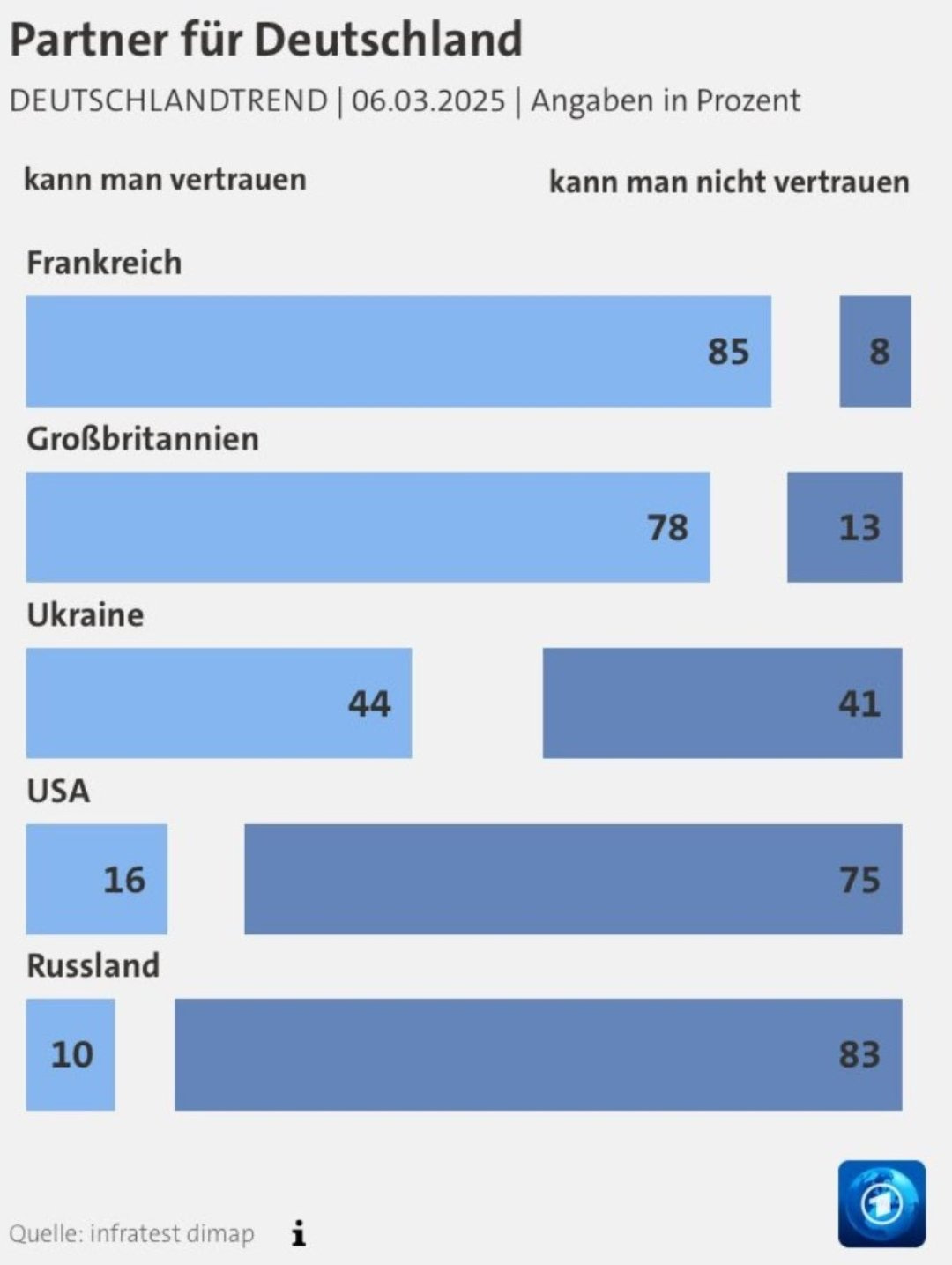
All that being said, public polling does indicate that the American fever is breaking among the public as well. The latest poll in Germany from this week found that only 16% of Germans now think they can trust the Americans - only 6% higher than Russia. By contrast, 85% of Germans now say they can trust the French - something that would have astonished their grandparents. Europeans are finally waking up to the fact that they are much better off trusting each other than trusting the Americans. Their failure to understand that for so long, a failure that has been particularly strong in the EU’s East, has been one of the biggest blocks to European unity, sovereignty and strength.
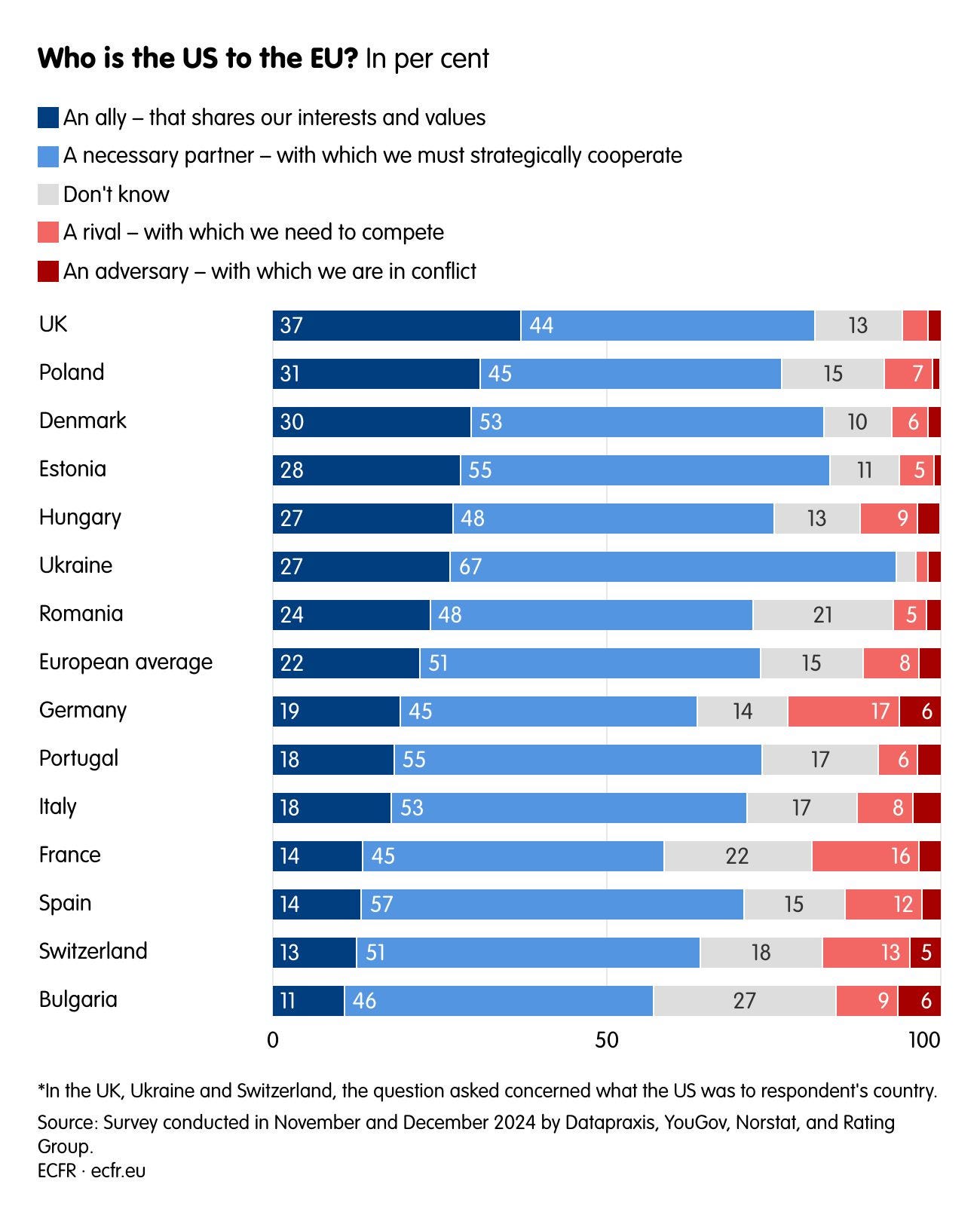
The proportion of Eastern Europeans who still trust America is still naively high, and it will take some time to fully knock down the good will that still lingers there because of America’s roll in tearing down the iron curtain 40 years ago. But overall, there is a downward trend. Last month, the latest survey from the European Council on Foreign Relations found that only 22% of Europeans still consider the United States an ally. Most Europeans (51%) now feel like prisoners in a toxic relationship, saying the US should only be considered a “necessary partner” with which Europe must cooperate because of its size - the same language that European leaders only use for China. Even in staunchly Atlanticist Poland and Britain, only 31% and 37% respectively say the US is still an ally.
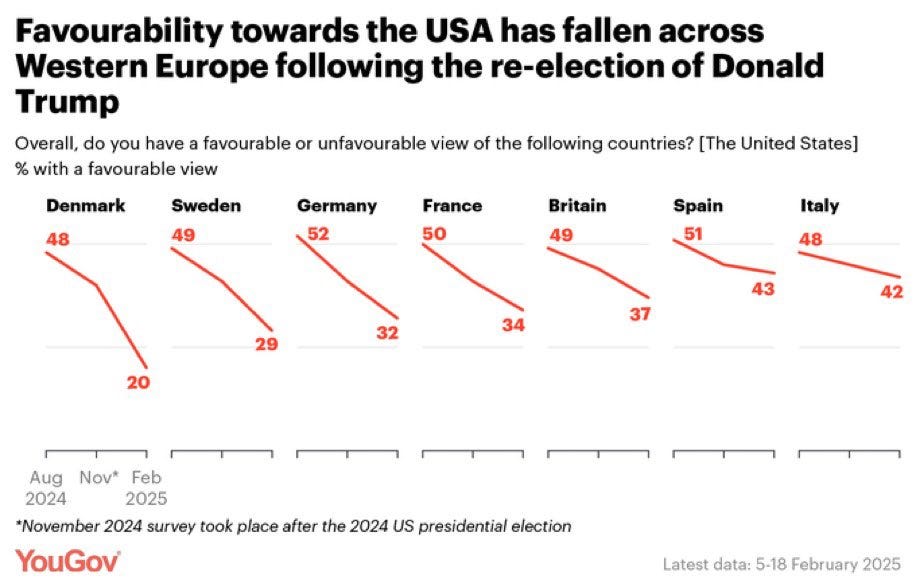
YouGov tracked European favourability toward the United States from August 2024 to February 2025 and saw huge drops, especially in Denmark where today only a fifth of Danes like America, compared to half of them six months ago. Even in Italy, whose the far-right Trump ally prime minister is quite popular at the moment, the favourability has fallen.
My question, however, is whether this new distrust of the United States will translate into an understanding that it means Europeans have to take action in response. I think it is likely that most of the people indicating their current dislike for the United States don’t fully understand just how much the United States controls their lives. Over the years, when Europeans have wanted to talk to me about US politics and ask why Americans vote the way they do, I tell them the better question they should be asking themselves is why the way Americans vote is so important to them. I get bemused stares in response. People here have not been encouraged to think critically about the role of America in their lives, the space it occupies in their news media and on their TV screens, and the power it has over their politicians. That is the key ingredient people need to be made to understand. It’s all well and good for Europeans to have taken off their rose-coloured glasses when it comes to America, but if they don’t understand that this has major implications for the sacrifices they’re going to have to make to liberate Europe from America, then what’s actually the point of the realisation?
The constant refrain lately has been that “Europeans need to turn words into action”. I think this applies just as much to the words of the average European citizen who is shocked and disgusted by what they’re seeing happen in the United States. Those words needs to be turned into action. And the action needs to be the federalisation and rearmament necessary to decolonise this continent from its American overlords. This will require a wholesale change in thinking and some major sacrifices. Are Europeans ready?
We had friends over for dinner. We are all professional class people, living in Munich, raising school age children. They keep up with current events but aren't ardently political. One works for a US firm.
I was curious what they would think of the massive investment in defence. 'Wir haben keine Wahl, wir müssen' (We don't have a choice, we have to) was their matter-of-fact response.