

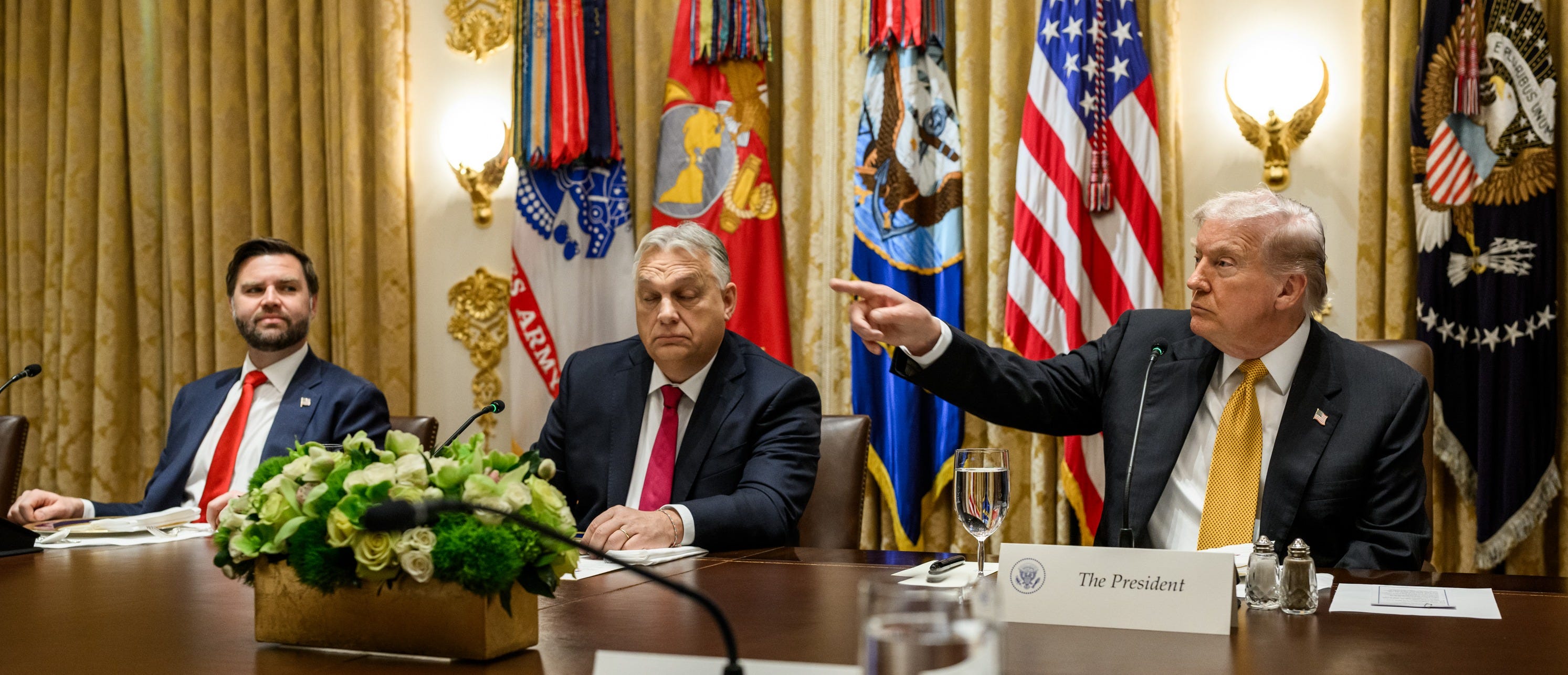
After 16 years of increasingly autocratic rule, Viktor Orban has been ousted from power in a landslide defeat. It is a humiliating blow to the Trump administration after a desperate and unprecedented bid to save their ally over the past weeks.
Orban’s Fidesz is set to finish with just 55 seats (down from 135) in the 199-member Hungarian parliament, while his challenger Peter Magyar’s Tisza will have a supermajority above 133. Fidesz got 37% of the popular vote while Tisza got 53%, a whopping 16% difference far higher than the 11% that was being predicted by polls. What really killed Fidesz was that they lost their core rural conservative voting base. Orban has been defeated so severely that there is no hope of contesting the election as some had feared. He has already called Magyar to concede defeat. Europe’s longest-serving prime minister has been ousted - a seismic development with implications both for the EU’s support to Ukraine and for Europeans’ fear of Donald Trump.
The most immediate impact will be that the EU’s €90 billion loan to Ukraine, necessary to replace the US support that Trump has ended, can now move forward. Orban had signed off on the loan in December in exchange for an arrangement where Hungary will not have to contribute to it, but he changed his mind last month and said he would veto it, possibly as a ploy in the election campaign. More generally, the EU will no longer have to deal with the persistent threat of Hungarian vetos on anything Ukraine-related. Over the past two years the European Council has started the new tradition of adopting seperate conclusions on Ukraine only as 26 or 25 rather than the full 27 EU members. It remains to be seen whether Slovakia’s Robert Fico, another Putin ally, will try to continue Orban’s obstruction on his own (more on that below).
Since the outbreak of the war in Ukraine Orban has served as a spoiler blocking EU action – by using the power of any national leader to veto foreign policy decisions. This ability to sabotage the union has been compared to the liberum veto in the Polish-Lithuanian Commonwealth which was successfully exploited by enemies to the East (Russia) and West (Germany) to wipe Poland off the map in the 18th century. Over the past four years Orban has used this veto to block EU assistance to Ukraine and European rearmament efforts. They will be dancing in the streets tonight in Kiev.
A European rejection of MAGA
Orban’s defeat will accelerate a trend we’ve already been seeing of the European far right distancing itself from the Trump regime. Orban not only fully backed the invasion of Venezuela and the US-Israeli war on Iran, he also let the White House take centre stage in the last days of his campaign. While Russia’s support in the campaign was behind the scenes, America’s was open and overt. Earlier today, as Hungarians went to the polls, Donald Trump Jr. tweeted a photo of himself with Orban and told Hungarians, “We hope you will vote for my father’s friend and ally. One leader in Europe has a direct line to the White House, I hope you will support Viktor Orban!” It turns out that Europeans right now don’t think having a direct line to the White House is an asset, because that direct line is a one-way communication telling Europeans what to do. While Orban talked of Hungarian sovereignty, he signalled to voters that he was willing to sell Hungary’s sovereignty to the highest bidder, be in to Vladimir Putin or Donald Trump.
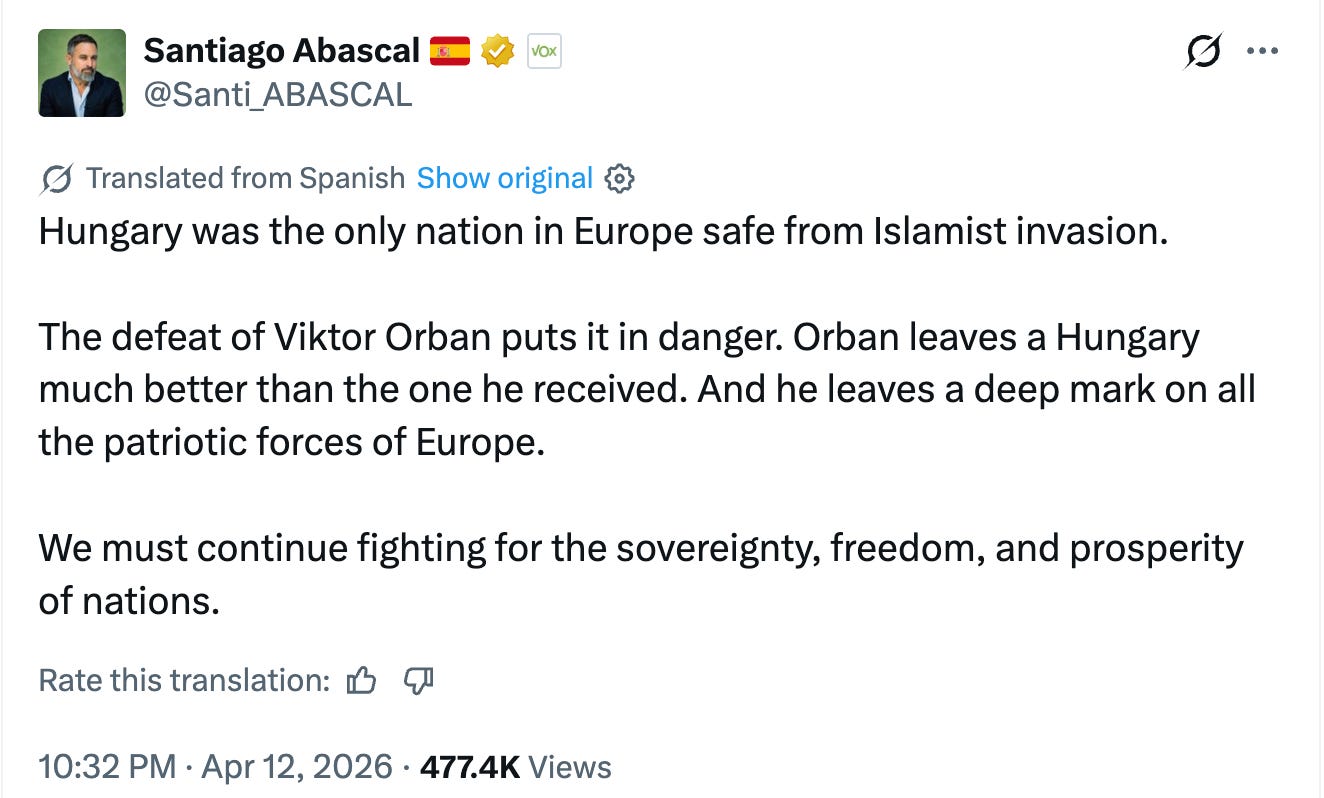
The reactions from Europe’s right-wing leaders have varied considerably. Holland’s Geert Wilders and Spain’s Santiago Abascal both called the result a tragedy and predicted a Muslim invasion of Europe as a result last night. Marine Le Pen came out with something more clever, saying the accusations of “dictator” against Orban were clearly “grotesque” given he’s no accepted an election defeat (in fact the “illiberal democracy” model implemented by Orban and Putin has always allowed for overwhelming landslide votes to oust them, the point is that they stack the deck to make it extremely difficult). Giorgia Meloni came out with a fairly bland statement taking some distance from Orban despite having given him a full-throated endorsement in a campaign video alongside Le Pen, Abascal and Netanyahu three months ago. Acknowledging Magyar’s “clear electoral victory”, she said, “I thank my friend Viktor Orban for the intense collaboration of these years, and I know that even from the opposition he will continue to serve his Nation.”
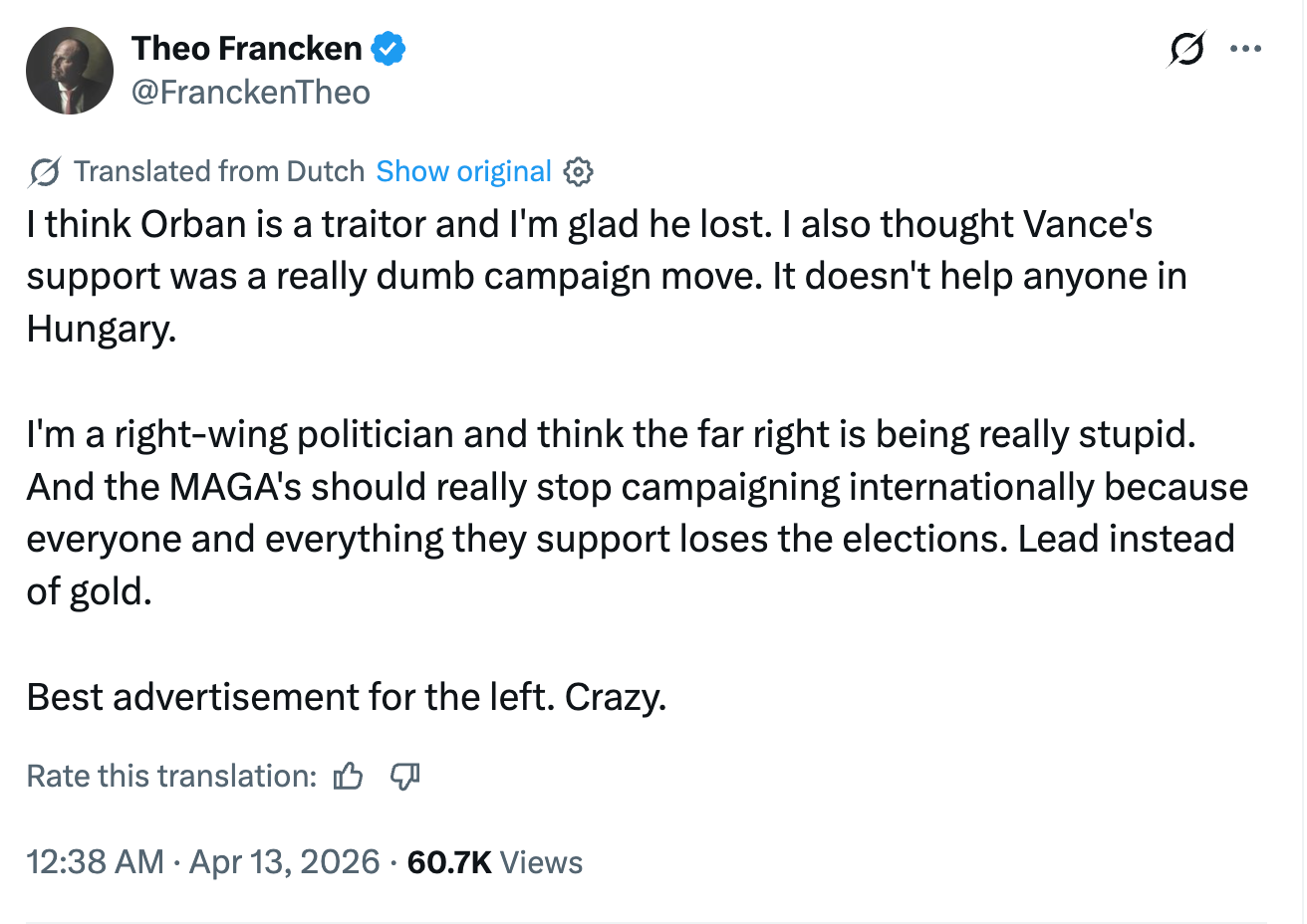
But it’s the reaction of Belgian Defence Minister Theo Francken, a political ally of Meloni in her ECR group and a frequent admirer of both Orban and Trump, which has been the most informative. “I think Orban is a traitor and I'm glad he lost,” he posted on X overnight. “I'm a right-wing politician and think the far right is being really stupid. MAGA's should really stop campaigning internationally because everyone and everything they support loses the elections.”
US Vice President JD Vance travelled to Budapest to campaign for Orban last week. At one event he called Donald Trump and put the US president on speakerphone for the world to hear the American endorsement: “Remember this, he didn’t allow people to storm your country and invade your country like other people have, and ruin their countries frankly,” Trump said. “He’s kept your country good, he’s kept Hungarian people in your country. And he’s done a fantastic job.”
“What has happened in the midst of this election campaign is one of the worst examples of foreign election interference that I have ever seen or ever even read about,” Vance later said with no hint of irony while standing beside Orban at a joint press conference. He of course wasn’t talking about his own interference happening at that very moment, but rather alleged interference by the EU, Ukraine, Germany and other European countries.
“We reject the accusation made by US Vice President JD Vance at an event in Hungary” Germany’s deputy government spokesperson told reporters during a press conference afterwards. “I would like to point out — since Vance is complaining about the EU’s alleged interference in the election — that the US vice president was in Hungary just a few days before the election. This fact alone speaks for itself as to who is interfering.”
A new spoiler cometh
There will be much celebrating in Brussels tomorrow. But hopefully, it will not lead to people thinking we’re out of the woods. Orban’s defeat does not spell the end of the EU’s problems, because the problems are structural. “The EU is dead if they don’t find a way to change decision-making from unanimity to qualified majority,” said Ukrainian pundit Olena Halushka last week. “Even if Orban loses, Russia will soon buy a new little helper among the European leaders. The problem is far deeper than Orban.”
In fact there is already such a little helper sitting in the Council: Slovakian Prime Minister Robert Fico. He is a different animal from Orban, having until recently sat within the centre-left Socialists & Democrats group rather than coming from the far right. But he is just as tied to Moscow, and he and Orban have been together wielding the veto since he returned to power in 2023 under a new Fico 2.0 pro-Russian populist platform quite different from his previous positions. He took that seat in the Council shortly after the far-right PIS party was ousted from power in Poland, effectively cancelling out that development because as long as there are at least two anti-EU leaders in the Council it is impossible to punish them. Under the EU’s Article 7 procedure which can withhold funds and voting rights from a country conspiring against the EU, 26 of the 27 EU countries must vote to trigger it. Fico will now be vulnerable to this procedure which could change his behaviour. But it is likely that the populist Czech prime minister Andrej Babis would shield his Slovak counterpart.
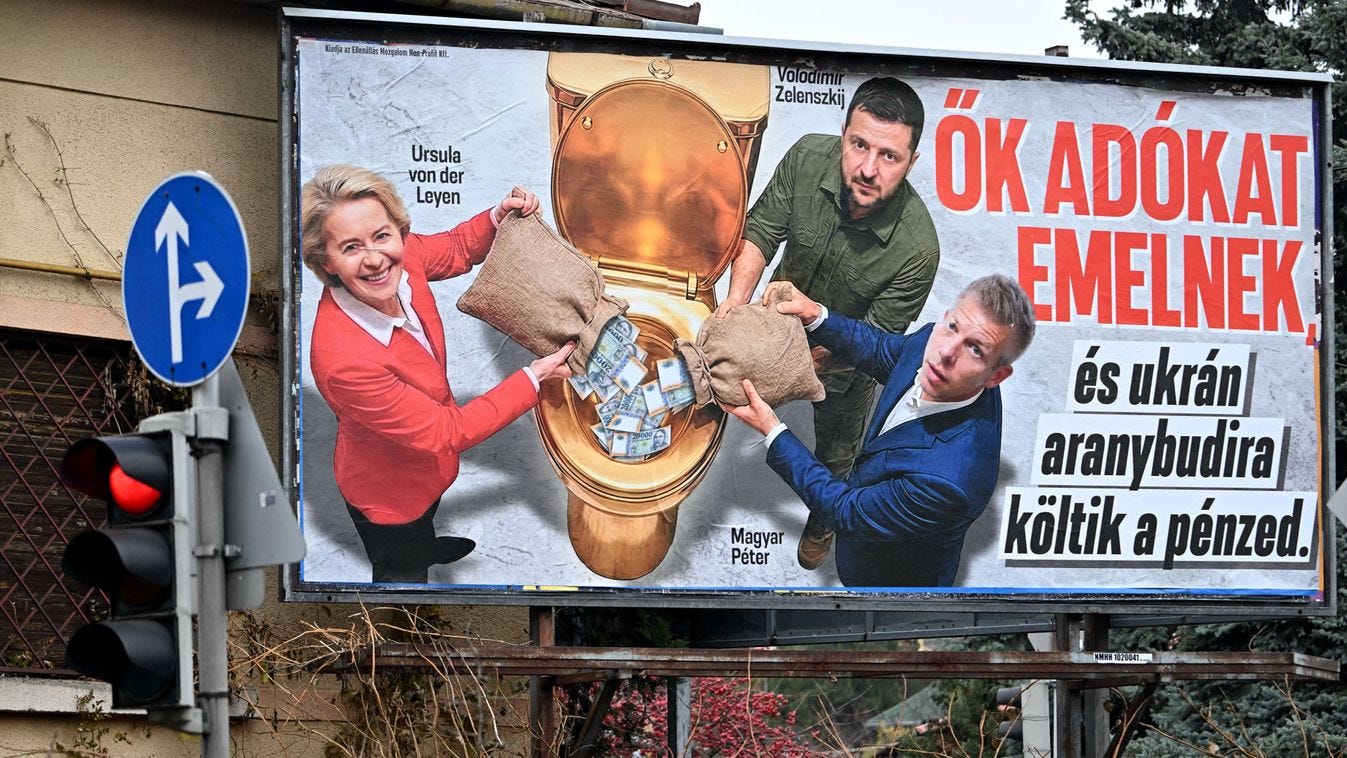
Magyar reconfirmed in his victory speech that he will immediately set about de-Fideszifying the government, media and judiciary which had become stacked with Orban’s cronies. He also has the supermajority required to de-Fideszify the Hungarian constitution which was replaced by Orban in 2011 to give his party absolute control. He said he will prosecute the Orban officials guilty of corruption.
But these are governmental changes, not political ones. Political opponents of Orban need to keep their expectations for Magyar in check. He is a conservative who until recently was part of Orban’s ruling Fidesz party. “Péter Magyar is not the anti-Orbán, he is running on a platform that is Orbán without the corruption,” noted pundit Martin Varsavsky. “As Orban, Magyar opposes the EU migration pact. He voted against the loan to Ukraine. He wants strong borders and has no plans to reverse Hungary’s energy ties with Russia before 2035. On every substantive question that defines the European left-right divide, Magyar sits exactly where Orbán sits. What he promises to change is governance, not ideology.”
Not out of the woods yet
Members of the European Parliament have tonight reacted with celebration, but also caution. “Welcome back, Hungary!” said Terry Reintke, Chair of the Green MEPs. “The election result is a clear defeat for Viktor Orbán, for his corrupt and kleptocratic system, and for the entire far-right movement, from Putin in Russia to the AfD and similar groups in the EU, to Trump’s MAGA in the USA. Democracy wins when we democrats stand together.”
Valerie Hoyer, leader of the Liberal MEPs, also welcomed the result but cautioned that Europe needs to understand that Orban exposed structural weaknesses in the EU that are not going to go away just because he was defeated. “The lessons from 16 years of the Orbán regime are clear,” she said tonight. “The European Union must rethink unanimity rules, limit veto powers in sensitive areas and equip itself with stronger tools to defend its integrity. If Europe is to move forward, we must move beyond a one-size-fits-all approach. In key areas, like-minded Member States should be able to advance together. A multi-speed Europe can no longer be a taboo.”
“Hungarian voters have chosen hope and a new political beginning,” she added. “They have demonstrated that even a deeply entrenched system can be challenged. The responsibility now is to turn this result into real change — for a pro-European Hungary that is a constructive and reliable member of both the EU and NATO. We have clear expectations: a new leadership must rebuild democratic institutions, deliver genuine rule-of-law reforms and establish robust anti-corruption mechanisms and support Ukraine. Tonight, we have one winner over all; the Hungarian citizens. With their outstanding record high participation they showed how vibrant and defensive a democracy can be.”
As Donald Tusk has learned in Poland, restoring the rule of law after years of erosion can be deeply challenging. But even though it is slow going, today’s victory against a deeply entrenched governing far-right party - just like that in Poland three years ago - shows that it is possible. And this is a game-changer of an even bigger magnitude than that Polish result, because it comes at a time when so many in Europe are otherwise feeling hopeless.
Nationalists ousted in Poland: a game-changer for the EU

For a decade Law and Justice has joined with Viktor Orban in dismantling the rule of law, curtailing press freedom and blocking EU climate action. It looks like Polish voters have sent them packing.
A blow for MAGA’s regime change efforts
We should bear in mind that Orban' has captured every part of the Hungarian state. While he has now lost control of the government, he will still control the media and judiciary. The big question is whether he will be able to continue being a pan-European MAGA figure while in opposition, as Meloni seems to be suggesting.
“Tisza’s win raises questions about the Budapest hub of illiberal thinkers and institutions that coalesced under Orban,” observed Jeremy Cliffe from the European Council on Foreign Relations (ECFR). “This has become an important node in European and US nationalist networks. But it remains to be seen whether this hub will stay put and seek to incubate a Fidesz comeback; decamp to another political centre like Belgrade, Bratislava or Washington DC; or disperse across Europe ahead of the major election year of 2027. Which path it takes may depend on the new Tisza government’s ability to dismantle the extensive architecture of financial support for the Budapest hub built by Orban and his allies.”
Nevertheless, even with all the caveats, 12 April will go down in history as a major defeat for MAGA’s regime change efforts in Europe. “This election could mark a real turning point for Donald Trump’s culture war in Europe,” says ECFR’s Pawel Zerka. “Over the past two years, Trump has tried to project political influence across the continent – backing ideological allies, attacking opponents, and undermining trust in the EU itself. Viktor Orbán’s Hungary was at the heart of that strategy, often held up as a model of ‘sovereigntist’ defiance against the liberal mainstream. And yet – despite last-minute support from JD Vance’s visit to Budapest to promises of major US investment – the strategy failed. Hungarian voters were not persuaded.”
“That should be a moment of confidence for pro-European forces across the continent: they are not powerless in the face of Trump’s political brand,” he added. “It may also force parties ideologically close to MAGA – such as Alternative für Deutschland or Rassemblement National – to reconsider how closely they want to align themselves with Trump. In the current context, especially after his controversial foreign policy decisions, that association may be becoming more of a liability than an asset.”
America is pursuing regime change in Europe

The far-right candidate won yesterday's presidential election in Poland, thanks at least in part to help from the Trump regime. Centrist EU governments need to realise America wants them out.