

On Friday, delegates at a much-anticipated summit of the International Maritime Organisation (IMO) in London were expected to agree to an emission-reduction plan years in the making. But following a fierce pressure campaign led personally by Trump, the Net Zero Framework shipping emissions plan was shelved. “President Trump saved America from the outrageous climate scam that was killing our country, and he has long warned others to abandon this destructive agenda before it is too late,” said a White House spokesperson afterwards. “Stopping this disastrous vote is a massive win for the American people and countries around the world.”
The successful US effort to kill the boat emissions-reduction plan was only the tip of the iceberg. Not content with just derailing global efforts, I’ve been told that behind the scenes US delegates were launching aggressive attacks against the European delegates pressuring them to drop the EU’s internal emissions-reduction measures on the shipping sector or face retaliation from the US in the form of new tariffs and (always implied) loss of US support for Ukraine. Specifically, the US delegates were “pushing for the EU to drop its own carbon pricing for shipping in the EU ETS [Emissions Trading System] and green fuels mandates as part of its FuelEU Maritime law,” says the NGO Transport & Environment.
“This is a shameless attempt to undermine Europe’s sovereignty,” says T&E Executive Director William Todts. What was even more worrying, says Todts, is that some on the EU side were actually ready to “torch vital climate measures that have been all the way through Europe’s elected Parliament” in order to convince the US to sign up to even a toothless IMO deal. “Some Europeans thought sacrificing the EU’s shipping rules might appease the Donald and his friends. He killed the deal anyways. The EU better remember that when he goes after CBAM.”
EU climate laws offered to Trump on a golden platter
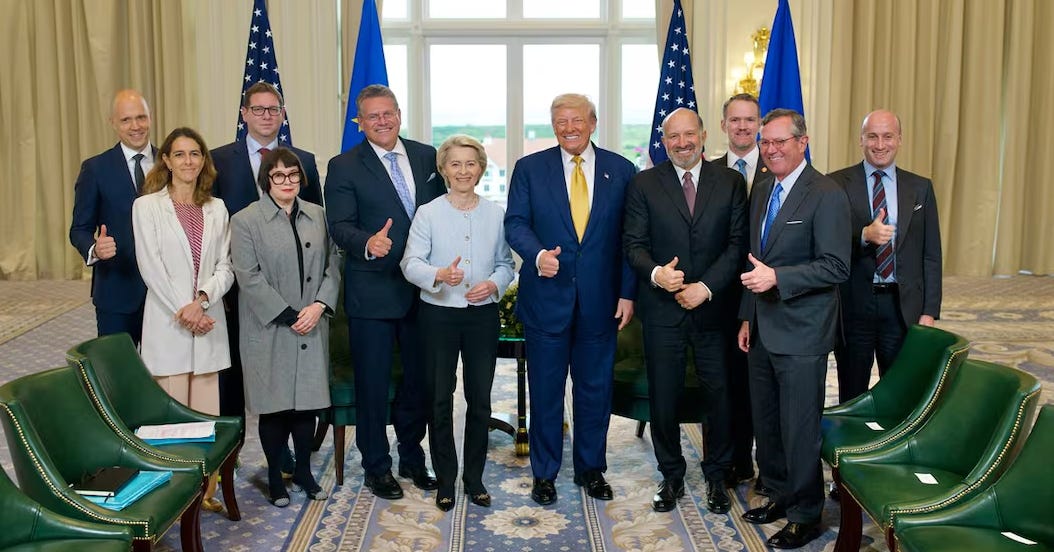
“No amount of concessions will ever satisfy Trump and the fossil fuel guys that work for him,” says Todts. But our EU leaders don’t seem to have understood that. The surrender deal signed by EU President Ursula von der Leyen in July explicitly offered to make adjustments to three climate laws that the US has “concerns” about: the Carbon Border Adjustment Mechanism (CBAM), which is designed to introduce import taxes for countries with less stringent climate legislation to combat carbon leakage, and the Corporate Sustainability Due Diligence Directive (CSDDD)/Corporate Sustainability Reporting Directive (CSRD), both of which are supposed to require companies operating in Europe (including American ones) to report on their climate impact. Those changes were dutifully rubber-stamped by MEPs last week. The deal also promised to revise EU vehicle approval laws to let monster SUVs into Europe.
Of most concern is the dilution of CBAM, without which the EU ETS—the bedrock of Europe’s climate action—will collapse. More on that below. The direction of travel here is clear. The EU, which already started backing away from climate action last year after voters indicated in the EU Parliament election that they no longer care about climate change (more on that result below), is now offering up its climate change legislation as the first sacrificial lamb to appease Trump. Meanwhile the EU’s reaction to Trump pulling out of the Paris Agreement is completely different from back in 2017. The EU showed up empty-handed to New York Climate Week last month, sending a clear signal that this time they are not willing to expend political capital on defending the Paris Agreement.
The Paris Agreement is unravelling
While the EU managed to keep a global coalition of the willing together during the four years of Trump’s first term when he pulled the US out of the UN’s Paris Agreement on combating climate change, there has been no such effort this time. As someone who has been covering EU climate and energy policy for 15 years, it has been astonishing to me how in the course of just a year since the US election, EU climate efforts have slowed to a trickle and are now even moving backwards.
In November 2017, I was in Bonn Germany covering the 23rd UN Framework Convention on Climate Change summit (COP23), and it was a very interesting time to be there. Donald Trump had just pulled the US out of the UNFCCC and its Paris Agreement committing countries to make emissions reductions. But US states were determined to show the world that the US absence was just temporary. They formed the We Are Still In coalition, along with American businesses, and they managed to have the largest pavilion at COP23. It was led by California Governor Jerry Brown and New York Mayor Michael Bloomberg. It was a bizarre situation because, at the same time, officials from the Trump administration had shown up to the summit even though they had pulled out. There were two rival US delegations in Bonn. I wrote in an article for Forbes at the time:
“Both the official and unofficial delegations are claiming to be the ‘true’ voice of Americans when it comes to climate. It has left the bemused representatives in Bonn wondering which one of them to speak to in order to get a real sense of what America is thinking and what it intends to do in the future. Alden Meyer, director of strategy and policy at the Union of Concerned Scientists, thinks the world should listen to the unofficial delegation. “My view is that the sub-national delegates truly represent the interests of Americans, they are closer to public opinion on this,” he said in Bonn. ‘Countries can’t negotiate with Governor Brown, they have to negotiate with the person in power. But they also understand that this is an aberration, and whoever takes power after President Trump will restore the US back into the Paris Agreement’.”
In January 2021, that advice seemed vindicated. Joe Biden took America back into the Paris Agreement, which had been held together in the meantime by the EU, China and the American state governors. But when Trump returned to office in January 2025 and once again took the US out of the agreement, the same thing hasn’t happened. There is no visible We Are Still In coalition, no delegation of state governors insisting this is just a momentary blip. Democratic state governors are busy defending their citizens from Trump’s military incursions. The EU is not making visible efforts to keep the Paris Agreement together either. President von der Leyen showed up the UN Climate Week in September 2025 empty-handed, with no new emissions-reduction targets and only news of how she was dismantling her own climate change legislation back home.
EU climate laws rescinded
Europe has long been the leader in fighting climate change, both in its own domestic policy and in leading global efforts. There is a reason that the landmark global agreement to cut emissions was signed in Paris. The EU passed the world’s most ambitious and comprehensive package of legislation to fight climate change as part of the EU Green Deal of Ursula von der Leyen’s first term from 2019 to 2024. Almost half of the EU’s electricity (47%) came from renewable energy in 2024, compared to 24.2% in the US. The EU has the most stringent climate targets of any major economy in the world: a 55% reduction compared to 1990 levels by 2030, and a goal of reaching net zero emissions by 2050.
But the war in Ukraine has put climate concerns on the back burner as EU citizens grapple with more immediate existential threats. This was evident in the European Parliament election of June 2024. In the 2019 EU election, climate change was listed in exit polls as among the top concerns for voters—and that is why we got the EU Green Deal. But five years later, the issue fell way down the list. In 2024 the majority of Europeans voted for centre-right or far-right parties that campaigned against the Green Deal and said they would scrap climate laws, and this proportion was even higher among Gen Z voters who made a big shift toward the far right. The Greens lost a third of their seats in the European Parliament in 2024.
Von der Leyen's bonfire of the climate laws

Today the EU backs away from its Green Deal, as concerns over near-term security threats overshadow the long-term threat of climate change. But some argue today's reframing will help climate efforts.
Elections have consequences, and as a result of the 2024 election President von der Leyen has proposed a series of measures to walk back the Green Deal, which has now been replaced by the new “Clean Industrial Deal” which is supposed to balance climate concerns with business needs. The president’s bonfire of her climate laws started with the “Competitiveness Compass” in January 2025, which outlined ways to roll back climate legislation in the name of cutting red tape. Then in February came the Omnibus Proposal for deregulation, which among other things scraps sustainability reporting for companies. Her surrender deal with Trump has accelerated these efforts, because the Commission is now presenting this as part of that deal. The deal has also committed Europeans to buying $750 billion in US liquified natural gas. That will require new infrastructure to be built at European ports to receive, which will lock Europe into fossil fuel imports for decades to come.
After escaping Russian energy dependence, Europe is locking itself in to US LNG

The US energy secretary says the quiet part out loud: the tributary $750 billion in energy purchases the EU has promised in its Trump deal is meant to lock Europe into "long-term" energy dependence.
So in short: the EU was already planning to roll back its climate legislation before Trump was elected, but the US president is now turbo-charging the EU’s green backtracking. Some are calling this phenomenon “greenlash”—a backlash to a perception that green policies are costing a lot of money and making people poorer. But it isn’t just economic concerns. Action to tackle climate change has become part of the culture wars in the United States, and America’s culture wars now quickly spread to Europe thanks to social media.
European politicians seemed most enthused about tackling climate change when they thought the US was tackling it as well. When the US Congress passed the Inflation Reduction Act in 2022, President Biden had the gall to call it, “the largest climate bill in the history not only of the United States, but literally in the history of the world.” It was an absurd claim given that the IRA contained no actual regulatory requirements or targets but was rather a theoretical availability of billions of dollars of financing for cleantech through tax incentives. By any reasonable definition the EU Green Deal’s Fit for 55 package is the largest climate bill in the history of the world by far. But Europeans eagerly parroted Biden’s ridiculous premise. Ever since 2022 I have been hearing non-stop from industry groups at energy events in Brussels about how the IRA meant the US is now the world’s cleantech leader and companies were going to move to America unless the EU lavished them with subsidies and deregulated in order to keep them here. The Commission also swallowed the narrative and offered European industry a number of measures to level the playing field with the IRA, including new funding and a deregulation drive.
But the Trump regime has already destroyed the IRA. The One Big Beautiful Bill Act cut almost all of the financial support for renewable energy and cleantech that had been in the IRA. They almost didn’t even need to do that though, because investor confidence in American cleantech had already been shattered even before the OBBBA was passed.. An analysis by energy intelligence firm Kayrros published in July 2025 based on satellite data found that solar installations had dropped nearly 50% since Trump’s election.
ETS in danger
The EU’s carbon border levy (CBAM) is supposed to take effect on 1 January 2026. But with a little over two months to go, European companies are in a panic saying they don’t have enough information about how it’s going to work. They are also unnerved by the US attacks on CBAM and the Commission’s seeming readiness to trade it away as part of its surrender to Washington. European businesses want CBAM—the whole point is that it’s supposed to protect them from competition from companies that don’t have to face stringent climate regulation like companies in Europe do. If there is no CBAM (or a weakened one), then they say they need to be compensated by axing the EU’s emissions reduction efforts. And then you can kiss goodbye the idea that the EU can meet its emissions reduction targets of 55% by 2030 and net zero by 2050.
While they’ve waited for the CBAM, Europe’s emissions-intensive industries have been receiving free credits in the ETS, a market exchange where companies are supposed to pay for permission to pollute. As I detailed in European Voice back in 2012, when the EU ETS was set up the assumption was that the US would be setting up a parallel cap and trade scheme that the ETS could link to. Both Barack Obama and John McCain were promising one as part of their 2008 presidential campaign platforms. But because it was Obama who won and ended up proposing it, and the Republican Congress pursued a strategy of rejecting everything Obama opposed, they killed the US cap and trade system even though it had been part of their 2008 campaign platform as a market-driven capitalist way to fight climate change.
So the EU was left in the lurch, left without another major system to link to and the prospect of European companies facing unfair competition from American companies who could pollute however much they wanted. The free allowances were meant as a temporary way to solve that until the CBAM could be developed. If CBAM is gutted, and free allowances are extended indefinitely, then it renders ETS completely pointless. It won’t drive businesses to invest in cleantech as was intended.
“The USA under Trump is not looking to slow down clean energy and climate action,” says Todts. “It wants to destroy it. The sooner we fully accept the implications of this, the better.” This isn’t a question of an “isolationist” Trump wanting to not participate in global climate action. The Trump regime wants to destroy global climate action, including EU laws governing this continent.
As I’ve written about many times on this Substack (I know I’m starting to sound like a broken record), European citizens (both in the EU and UK) have no idea how much their leaders are surrendering to Trump right now. This is impacting many areas, and just one of them is climate. The EU spent the past decade putting in place the most stringent climate legislation in the world and becoming an indispensable leader in the global fight to lower emissions. All of that may be thrown away in just a few months because our leaders don’t have the courage to stand up to Donald Trump’s extortion.
Anyone who cares about climate change (let alone democracy, dignity and peace) should be up in arms about what is happening. But based on their lacklustre reaction to what has been happening (it seems the Fridays for Future people are taking a nap?) it would appear that those exit polls from the 2024 EU election are true. Maybe the public just doesn’t care any more about climate change when they have more immediate concerns about war vs peace and autocracy vs democracy. It’s just a shame that our politicians right now don’t seem to have given a thought to how this climate surrender is related to those very issues. If the EU can be so easily extorted into ditching its climate laws, what will they be willing to give up next?
Europe's surrender summer

Those defending the EU's "trade deal" with Trump are missing the forest for the trees. Whether or not the EU can actually make the payments promised, von der Leyen has cemented subservience.