
Europe has all the tools it needs to be free, but Europeans are afraid to use them
Over the past months, this continent has collapsed into a mire of fatalistic thinking. Mario Draghi is trying to remind us of the strength we possess. But Europeans don't believe in themselves.

I’ve been outside the Brussels bubble travelling around Europe this summer, spending time in France, Spain, Britain, Italy, Poland, Turkey and Greece. In talking to people about the current situation, a grim reality has become apparent. Europeans are largely unaware of the degree to which what is happening in the United States is impacting them, and they have not received the news about all the concessions their elected leaders have made to Donald Trump over the past months. Even more worrying: those who are aware have shrugged and concluded that Europe has no choice. This continent could never stand up to America because “we are shit” (as one person told me).
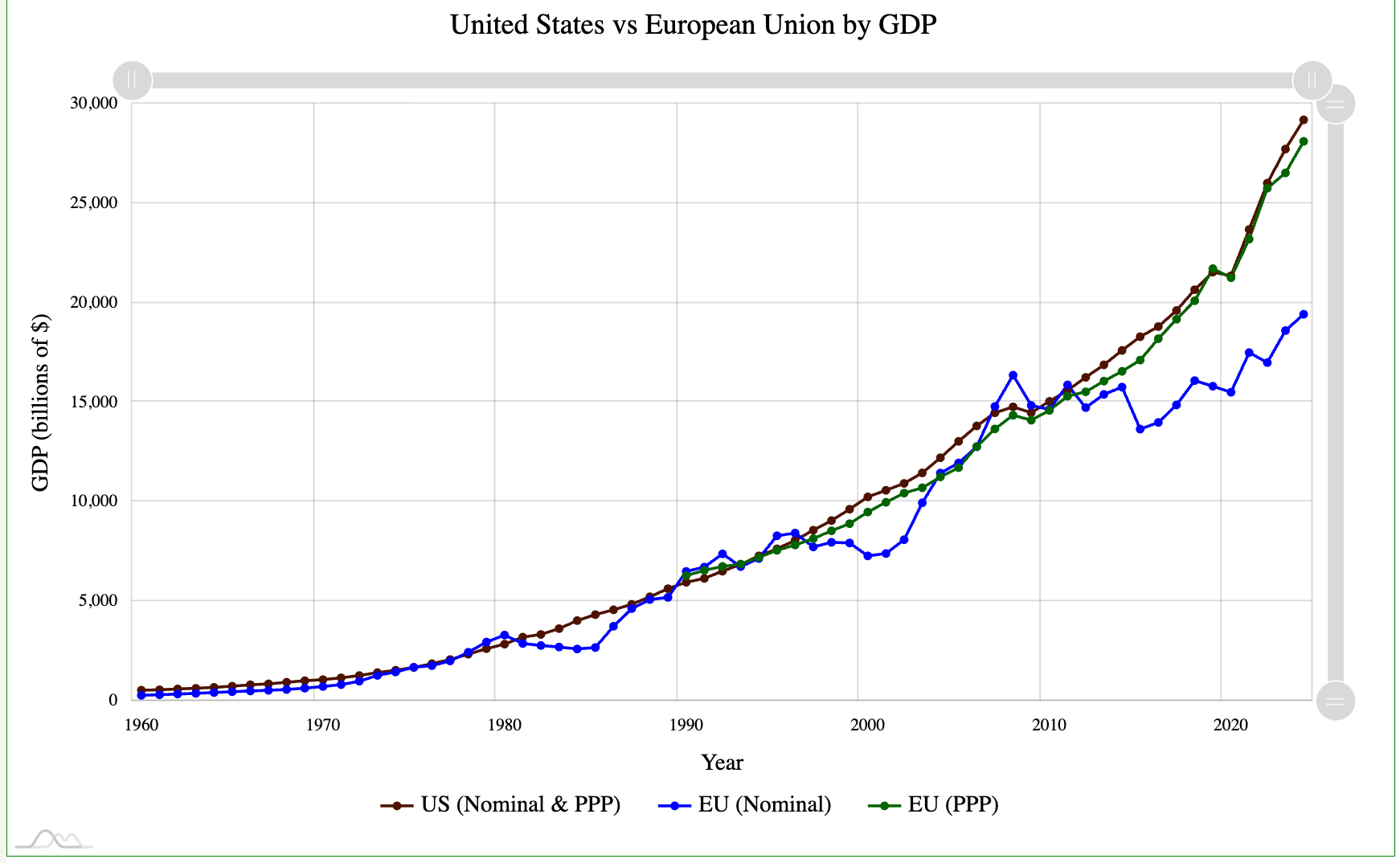
This idea of a “self-confidence gap” between Europeans and Americans is an idea I’ve explored for many years. The EU is larger than the United States and just 14 years ago it had a higher GDP than the US (and still today has an equal GDP by Purchasing Power Parity). On paper, there is no reason why Europeans should be so readily surrendering to Donald Trump this summer. But the problem is that Europeans do not believe in themselves. They do not understand their own strengths and potential. They are conditioned from birth to believe that America is better than them and always will be. I have been very critical of our European leaders surrendering to Trump so readily this summer and betraying their citizens. But let’s get real - Europeans get the elected leaders they deserve. The fact is that our leaders are not standing strong to defend Europe from Donald Trump because their citizens are not asking them to. They are reflecting the general mood of fatalism on this continent.
This fatalism was not only reflected in attitudes toward America’s control over this continent. I’ve also heard, particularly in Southern Europe, an ambivalence toward the prospect of Ukraine being forced to surrender to Russia. This is a conflict that doesn’t concern us, people in Spain and Italy told me. The Eastern territories of Ukraine should be handed over and Europe’s relations with Russia should be restored. When I posited that appeasing Putin now will invite him to invade the European Union within a few years, they found the idea preposterous. When I said there are clear Russian interests in invading the Baltics, it didn’t seem to have occurred to them that the Baltics are part of the European Union and Spain and Italy would, as EU and NATO members, be obliged to defend them. What if Trump’s America does not intervene in Putin’s invasion of the EU or even colludes with him in the attack, I asked. I was greeted with shrugs. ‘There’s nothing we can do.’
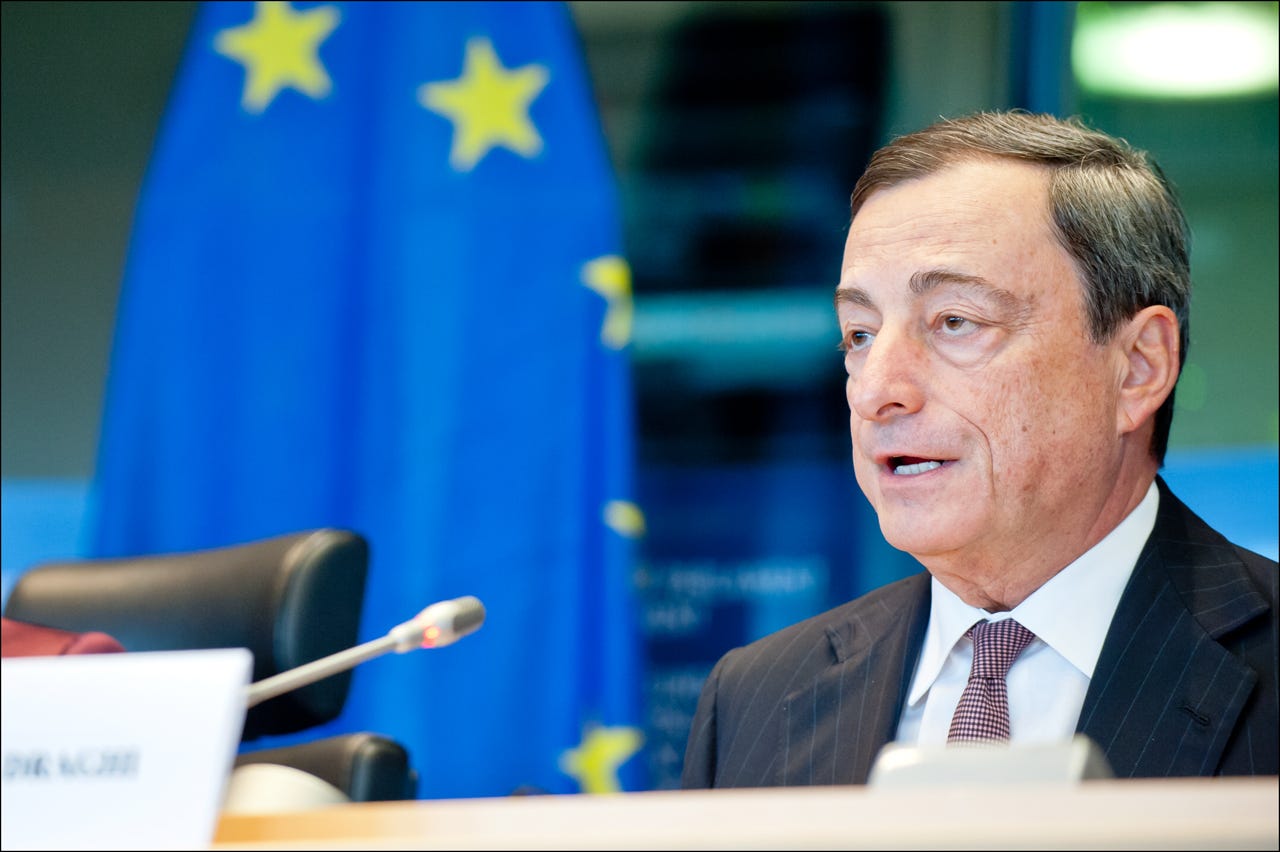
It is this climate of fatalism that the former Italian prime minister and ECB chief Mario Draghi is battling against as he tours Europe this week making an impassioned plea for Europeans to wake up to the threat they face from East and West. The man who was a contender to replace Ursula von der Leyen as EU commission president last year warned that Trump’s success in forcing Europe into surrender this summer shows the incredibly dangerous position this continent is in at the moment.
“For years, the European Union believed that its economic size, with 450 million consumers, brought with it geopolitical power and influence in international trade relations,” he said in a speech in Rimini, Italy last Friday. “This year will be remembered as the year in which this illusion evaporated,” he told the audience, calling this a “very brutal wake-up call” for Europe.
"We had to resign ourselves to tariffs imposed by our largest trading partner and long-standing ally, the United States. We have been pushed by the same ally to increase military spending, a decision we might have had to make anyway — but in ways that probably do not reflect Europe's interests.”
“Europe was a spectator as Iranian nuclear sites were bombed and the massacre in Gaza intensified. These events have shattered any illusions that economics alone would ensure any form of geopolitical power.”
Draghi then repeated these warnings in a speech to Nobel laureates two days ago. Europe does not have to be weak, he insisted. It has all the tools to be a major global player. But the EU’s existing structures are not up to the challenge that this new era of great power politics is presenting. “Models of political organisation, especially supranational ones, emerge partly to solve the problems of their time,” Drahghi said. “When these problems change to the point where the pre-existing organisation becomes fragile and vulnerable, the latter must evolve.”
This summer I have heard so much scepticism about the EU, with many pointing out the hypocrisy of condemning Russia for its invasion of Ukraine while staying silent on the horrors happening in Gaza. Many Europeans are saying the EU is useless because the EU has been behaving in a useless way. “It is therefore not surprising that skepticism toward Europe has reached new heights. - but it is important to ask what this skepticism is really about,” Draghi said in this speech. The danger, he said, is that if the EU fails to stand up to the US, Russia and China then its raison d’etre is lost. People will gravitate toward nationalism that will make the problem even worse. “It is clear that destroying European integration in order to return to national sovereignty would only further expose our continent to the will of the great powers,” he said. “Recognising that economic strength is a necessary but not sufficient condition for geopolitical strength could finally initiate a political reflection on the future of the union.”
When the EU was created (first as the coal and steel community after World War II), he said, it was trying to solve the most pressing issue of the time: that “previous models of political organisation - nation states - had failed in many countries to uphold [democratic] values.” It then evolved into a “neoliberal phase” that thrived in the global environment of the three decades from 1980 to 2010. But this era is over. “Europe is ill-equipped in a world where geoeconomics, security, and stability of supply sources, rather than efficiency, inspire international trade relations. Our political organisation must adapt to the demands of its time, even if they are existential: we Europeans must reach a consensus on what this entails.”
As Peder Schaefer noted in his Substack Going Transatlantic yesterday, “the European Union was built for the late 20th century. But the 21st century is increasingly defined by 19th century-style imperialism.” The go-to response of our leaders, and also Draghi, has been to focus on Europe’s “competitiveness gap” with the United States. It’s certainly an issue that needs to be addressed. But it’s also a convenient go-to remedy because it doesn’t involve actually challenging any foreign power, and leans on the EU’s undisputed core competence of economics. But Schaefer noted that it does not actually solve the problem that Draghi is outlining:
“Economic and productivity declines are a problem for Europe, but they will not solve the bloc’s geopolitical woes, nor turn Europe into a protagonist again in global politics. Instead, only an internally-driven political desire to push further European integration at the level of foreign and security policy can do so. Even if the EU itself refuses the term empire, it must be able to operate with the speed and decisiveness of its imperial neighbours.
The problem is that our current cadre of European leaders do not have the courage to pursue this route, particularly our EU president. Back in April 2024, as Europe’s leaders were considering whether to re-elect President von der Leyen for a second term, I wrote that she was plainly ill-suited for a world in which Donald Trump might retake the White House. She does not challenge the national leaders, which is a major problem when the group-think instinct in the European Council right now is to keep their heads down and surrender. Von der Leyen could be using her bully pulpit to lead the leaders into a strong response. She has not, because that is just not her personality. She has readily complied with their instructions to surrender to the US president.
The EU's next president should be a bully

In the US, much is made of the "bully pulpit" which is used by the American president to get things done in Congress. Why have all EU presidents since Delors been reluctant to use theirs?
Yet von der Leyen is also a shrewd political animal who has brutally consolidated her power within the EU executive while not trying to exercise power outside of it. She has assembled a college of obedient commissioners who dare not challenge her authority (because they saw what happened to those who tried to challenge her, like Thierry Breton). But her efforts often seem to be toward concentrating power for power’s sake, rather than for the good of Europe. Sure enough, she has clearly seen Draghi’s recent interventions as a challenge to her power. And on Sunday she hit back with an article in several European newspapers defending her deal with Trump and other recent actions.
"Much has been written about this agreement, considerations that deserve a direct response," she wrote. “Imagine for a moment if the two largest economies in the democratic world had failed to reach an agreement and had started a trade war. This would have been celebrated only in Moscow and Beijing.”
But von der Leyen does not address the fact that just weeks after her agreement Trump has once again threatened to impose tariffs on the EU - this time for its digital laws. Von der Leyen’s humiliating surrender deal did not result in a trade war truce. It only demonstrated to Trump that he can easily intimidate Europe into doing his bidding. Von der Leyen’s appeasement strategy has already failed.
Earlier this week Gerardo Fortuna at Euronews imagined an alternative history if EU leaders had elected Mario Draghi as president instead of Ursula von der Leyen at the end of last year. “It's hard to imagine Draghi flying to Trump’s golf course and publicly endorsing the US narrative of imbalance, as von der Leyen did,” he wrote. “She dutifully repeated the US president’s false claim of “a surplus on our side and a deficit on the US side,” which Fortuna notes was “a statement that paved the way for the asymmetric 15% tariff arrangement between Brussels and Washington.”
But as I noted before, citizens get the leaders they deserve. There’s no point in Europeans complaining about our leaders and the direction of the European Union while they continue to elect Atlanticist national leaders who choose to appoint someone like von der Leyen. If Europeans were paying attention to the humiliating actions of their leaders during this summer of surrender, they would be furious. But my conversations over the past two months have demonstrated that they are not. Europe’s subservience to America is regarded as inevitable. It’s worth asking why Europeans have been conditioned into thinking that way, and that is the subject of the book I have been writing this summer. Spoiler alert: I trace the rise of American cultural imperialism as the key factor in conditioning the European mind to accept American overlordship. The book will hopefully be published in November, with a launch event in Brussels.
The main thing to keep in mind is that we’re not powerless, even if our leaders have been acting like we are. Europe could be strong. It has all the tools necessary to be independent. The problem is that we don’t use them. We must urgently change our thinking on this continent if we do not want to face an American-and-Russian-imposed “century of humiliation” like the one imposed on China by the European powers in the 19th century. But we are running out of time. And the main people who need convincing are the people of Europe, who somehow need to be taught to believe in themselves.
Europe's surrender summer

As she scurried to the tarmac after having been summoned by the US president to his private golf course in Scotland, the EU president hurriedly tried to justify the agreement she had just signed with him. “It’s the biggest trade deal ever” Ursula von der Leyen
Seems to me that a very small amount of people in Spain would openly support slicing Ukraine. But the number grows if you ask to do something to prevent it, sure.