
Faced with US hostility, EU hits the brakes on its climate plans
Today President von der Leyen proposed to massively water down EU emissions trading, the bedrock of Europe's climate policy that was originally meant to partner with a US system.

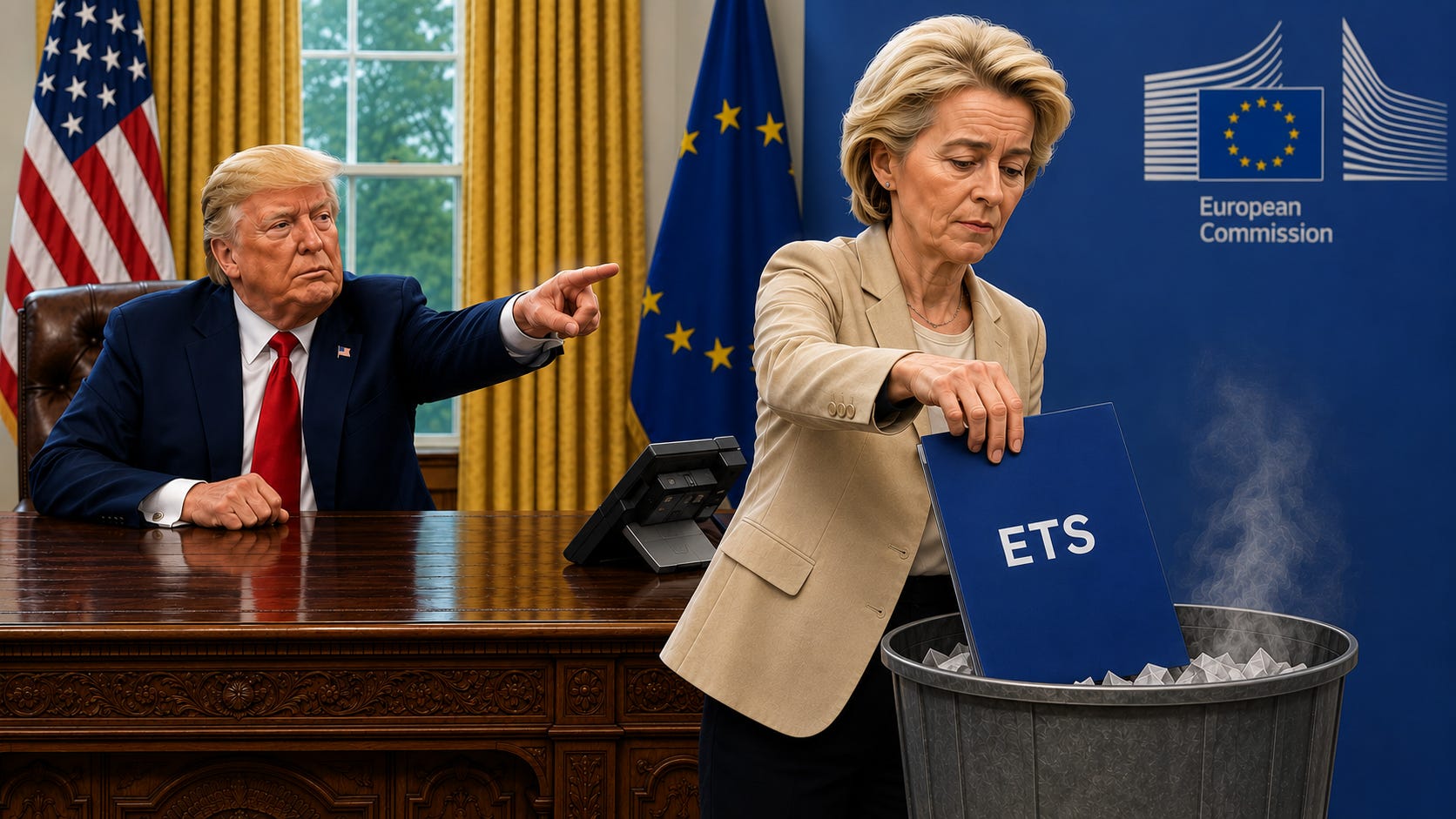
For decades, the European Union has been the world leader in policies to fight climate change. The EU Green Deal package in European Commission President Ursula von der Leyen’s first term is the largest climate law in the history of the world (despite President Biden’s ridiculous claims that the IRA was). But it now appears that the EU’s climate warrior era is over.
Today President von der Leyen unveiled an overhaul of the EU’s Emissions Trading System, the bedrock of Europe’s efforts to fight climate change. It’s not a complete suspension of the system as Giorgia Meloni was asking for in March, but as a I predicted back then, the ETS is instead being sent to a death by a thousand cuts. Today’s proposal, which will need to be approved by both houses of the EU’s legislature, would render the system moot by extending free allowances to emissions-intensive industries and allowing generous offsets. Basically, the system will still exist in practice but companies will not have to meaningfully pay for emissions for another decade, which means they will not be driven to invest in low-carbon solutions.

“Free pollution permits were never meant to become a permanent subsidy,” notes Greg Van Elsen from the NGO CAN Europe. “Extending them until 2038 rewards delay instead of industrial decarbonisation. Public support must reward companies that cut emissions, not business as usual or shareholder payouts.”
The extension of free allowances for several more years may seem like just a technical adjustment. But it is sending a signal to the markets that the EU will not stand by its legislation and will simply adjust it whenever the bill comes due if lawmakers face pressure from businesses and foreign governments. This has implications for many other policy areas, and suggests that the Commission will also chicken out once the bill becomes due for new carbon border levies (CBAM). Why should any company bother making investments in low-carbon technology when they can assume they’ll never actually have to pay for their emissions?
The fact that the carbon price is going up is not a flaw in the ETS, it is the whole point. Companies have known for 15 years that the price would go up at this point and they would lose their free allowances. Some companies prepared and made investments in low-carbon innovation. Other companies sat on their hands and did nothing. The laggards are now being rewarded. What a way to stimulate European competitiveness.
MEPs in the EU Parliament, and national governments in the EU Council, are split on this issue – so we can expect a major fight on this. While Italy, Germany and Poland are leading the charge to kill the ETS, France, Spain and Sweden are leading the charge to save it. Von der Leyen’s centre-right European Peoples Party, which also includes German Chancellor Friedrich Merz and Polish Prime Minister Donald Tusk, will lead the charge to push this through in the European Parliament, with the help of the far-right PfE of Marine Le Pen and ECR of Giorgia Meloni. Polish Secretary of State Krzysztof Bolesta told Politico that the ETS is a threat to “our European way of life” and the EU needs to “ditch dogmatism” in its climate approach. But Sweden’s Europe Minister Jessica Rosencrantz hit back, telling them “the ETS works. Europe should build on its success, not retreat from it.”
Since its launch two decades ago, the ETS has lowered emissions by more than 50% in the sectors it covers. More importantly, all EU climate policy has been built around it. As the centre-left S&D group noted in a letter to the Commission in July, it is “the cornerstone of the EU climate architecture”. Without it, all other EU climate efforts that have been passed into law over the past two decades fall apart.
Interestingly enough, the climate campaigners who are now desperately trying to save the system were actually against it at first. They warned that “cap and trade” (as it was being called at the time) was a conservative market-oriented solution to climate change that depended on future governments maintaining the credibility of the system. It essentially put off the hard work of fighting climate change by trusting the market to deliver reforms, but only in the future once free allowances stopped being given out. Under the system, the emissions that industrial companies can produce are capped, but they can purchase allowances to emit more. This incentivises companies to develop low-carbon technologies not only so that they don’t need to pay for additional allowances, but also so companies that are well below the cap can make money by selling their allowances.
But companies have been given high levels of free allowances in the first 20 years of the system in order to not penalise them before they’ve had the chance to develop the new technologies. Those free allowances are supposed to be phased out now. But that’s what this proposal would end, delaying that process by about a decade.
And yet, unveiling the proposal yesterday, the commissioners had the nerve to try to say this adjustment to the ETS was responding to the urgency of climate change and energy security. “The part that gets me: The Commission's own text says the ETS should be "lowering the EU's dependence on fossil fuel imports – their words, in the proposal itself,” noted Hans Stegeman, Chief Economist at Triodos Bank. “Then it lets industry emit more, longer, and hedge with foreign offsets instead of cutting at home.” “It's not just bad climate policy. It's also bad regulatory practice. Firms plan investments on the credibility of a price signal. Move the goalposts once, under pressure, and every future target becomes a starting position for the next round of lobbying.”
Did Obama kill the EU ETS?
Climate campaigner sceptics eventually learned to live with the ETS in the 2000s because it appeared that was the way the world was going. Market-based solutions for fighting climate change were being championed by both Republicans and Democrats in the United States, so it was assumed that the US would eventually start its own system. Having one unified method of fighting climate change in the West was better than having a market approach in the US and a regulatory approach in the EU, it was reasoned, and so Europe somewhat reluctantly got behind emissions trading following an initial pilot in 2005. Then they had the rug pulled out from under them – a story I tell in Chapter 7 of my book The Owned Continent:
“When the EU ETS was set up in 2008, the assumption was that the US would be setting up a parallel cap and trade scheme that it could link to. Both Barack Obama and John McCain were promising one as part of their 2008 presidential campaign platforms. But because it was Obama who won and ended up proposing it, the Republican Congress killed it as part of their openly-stated strategy of rejecting everything Obama proposed.
The Obama administration didn’t want to spend political capital on trying to save the climate law, preferring to spend it instead on Obamacare. So the US climate bill was abandoned and the EU was left in the lurch, stuck with an ETS that had no other major system to link to. That meant that European companies would face the prospect of unfair competition with American companies (something solved with free ETS credits up to 2026, transitioning to carbon import levies in 2026).”
The US failure to enact carbon trading 15 years ago was the first nail in the coffin of the EU ETS. But it is the current US administration’s wholesale abandonment of any climate policies (and its aggressive pressure campaign against other countries’ climate efforts) that has been the death blow. EU climate policy could survive with a ‘go it alone’ approach on emissions trading. It was working. But it apparently cannot survive in a scenario where it is being actively attacked by America. Because European businesses are saying they cannot compete in a world where they alone face climate burdens and their American competitors do not. And competitiveness is the Brussels mantra of the moment – at the insistence of Merzoni.

Or did European voters kill the EU ETS?
There are other factors at play here besides the MAGA regime’s hostility toward EU climate policy. Whether they understood it or not, European voters chose this path when they voted in the 2024 European Parliament election in a way that created a right-wing majority in the EU’s legislature.
That the Green Deal legislation happened during President von der Leyen’s 2019-24 first term was largely the result of the 2019 European Parliament election results, which happened at the time of the Greta Thunberg’s Fridays for Future marches. Green parties saw a big surge across Europe, and voters listed climate change as one of their main motivating concerns. But in the 2024 election the Greens were decimated, losing a third of their seats in the European Parliament. The public has, quite evidently, moved on from its concern about climate change. That may be because the immediate global concerns in the West about imminent democratic collapse and World War III put a more long-term concern like climate change back of mind. Or it may be that the public thinks governments can’t or won’t do anything to fight climate change (surveys have shown that both in the US and Europe people are unaware of the major efforts that were passed over the past five years with the IRA and the Green Deal). But the Fridays for Future crowd didn’t show up in the 2024 election, and we’re now living with the consequences.
Elections have consequences. And the impression that Gen Z is now ‘over it’ when it comes to climate change and is now voting for the far right in ever-increasing numbers, is in particular making politicians think climate change is now a losing issue with little political benefit in pursuing.

Or was it Trump?
The reasons why Europe is right now tearing up its climate change efforts are myriad. The EPP says they have been given a mandate to do so by the citizens in the 2024 election. European businesses are facing legitimate competitiveness concerns as they’re getting their asses handed to them by Chinese and American companies (though the degree to which this is due to EU regulation or the ETS is highly debatable). But it is also impossible to ignore the context of repeated European surrender to the Trump administration which is aggressively lobbying against EU climate policy (along with EU tech policy). The EPP and von der Leyen will insist this pressure has nothing to do with why they’re tearing up EU climate laws. That is hard to believe.
As part of her surrender deal with President Trump signed a year ago, President von der Leyen committed to Europe buying $750 billion worth of US liquified natural gas (LNG). If that promise is kept, it will be impossible to meet the EU’s target of reducing emissions by 55% by 2030 and to net zero by 2050. Investments are being diverted from renewables into building new gas infrastructure for the incoming American fossil fuel, which needs regassification facilities at ports and new pipelines. Meanwhile, von der Leyen is preparing to shred the EU’s methane law at at the US federal government’s request, even as Democratic lawmakers and US state governments are begging her not to.
At minimum, it is clear that EU climate policy is not important enough to von der Leyen and her EPP to defend it from US attacks. But they are going even further, jumping at the chance to obey US orders to gut climate laws. Whether they are doing so out of honest convicting that climate laws are hurting European competitiveness or cynical pandering to big business, this now seems like an unstoppable train. And with the EPP’s war on NGOs in Brussels having hallowed out civil society in this town over the past year, there isn’t much momentum to push back.
Future generations will look back at this moment as a pivotal turning point, the point at which Europe gave up on the idea that climate change can be resisted. We will be living with the consequences of that for decades to come.
