
Meloni was wrong, Macron was right
The Italian prime minister is trying to claim victory for Trump's retreat. But it was Europe showing its teeth through retaliation threats and troop deployment that spooked the US government.

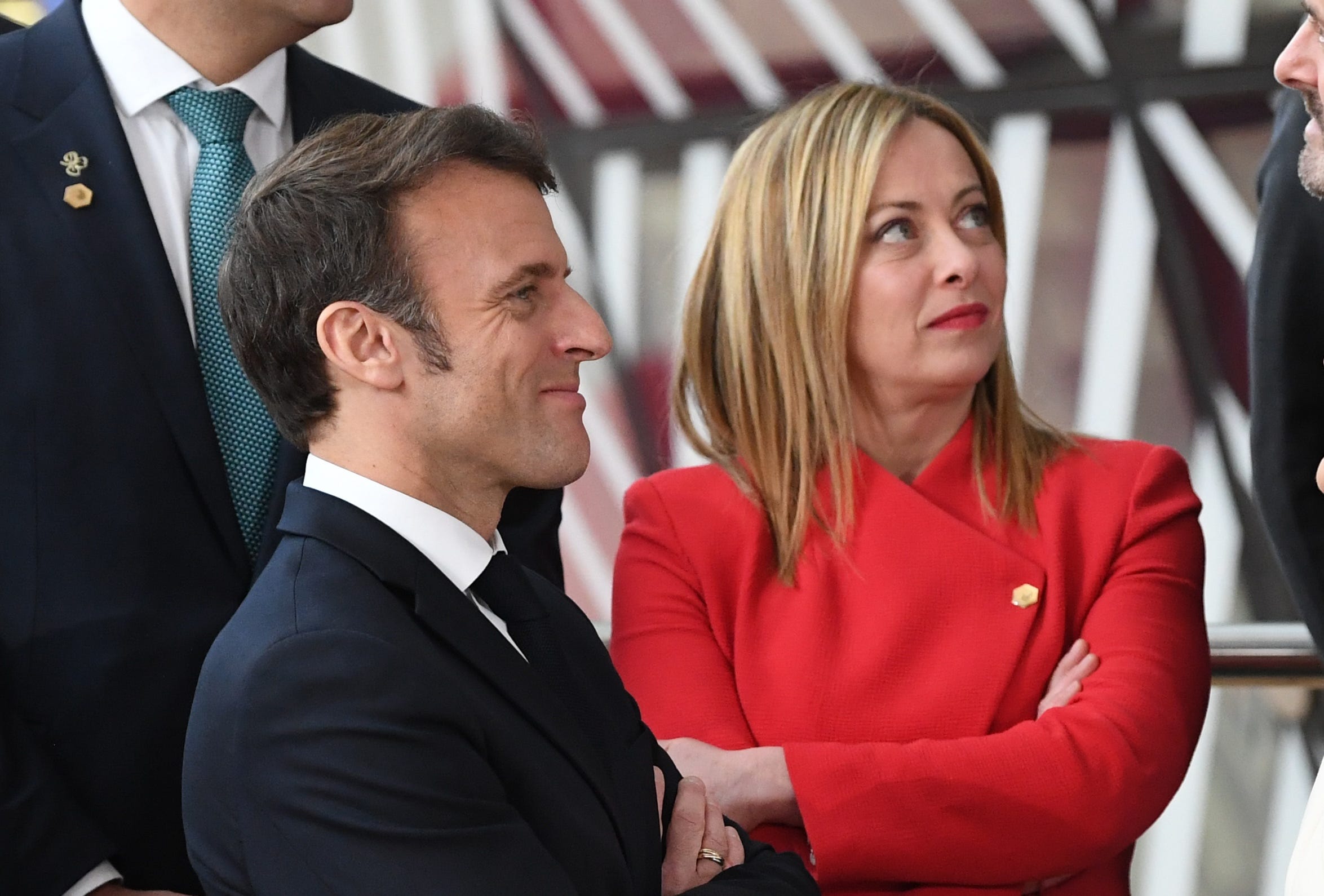
EU prime ministers and presidents are descending on Brussels as we speak for an emergency European Council summit that has now been pre-empted by President Trump’s sudden bizarre retraction of his Greenland military and tariff threats last night in Davos. Italian Prime Minister Giorgia Meloni is arriving claiming victory, crediting her daddy diplomacy for diffusing the situation. “As Italy has always maintained, it is essential to continue fostering dialogue between allied nations,” she published on X last night. But this would be the exact wrong lesson for Europeans to learn from this crisis.
Meloni is wrong. As the Morning Post Substack observed this morning, all indications are that Trump chickened out here because, unlike before, this time the Europeans stood up to him – even if the pushback lacked unity and self-confidence:
“If there is one lesson European leaders can draw from the past week, it is that deterrence—even minimal—works with Mr Trump. His renunciation of force was not a given, after he had promised to take Greenland “one way or another”. According to several observers, it is the result of the military deterrence organised by Denmark and a handful of European allies through the deployment of a small contingent of troops. Some EU member states mocked the operation. Italy’s defence minister, Guido Crosetto, dismissed it as “a joke”. In reality, the move caught the American administration by surprise. In Davos, the commerce secretary, Howard Lutnick, spoke of a “provocation”. Angered, Mr Trump announced tariffs on Saturday against Denmark and the other countries involved, accusing them of ‘playing a very dangerous game’. By placing on the ground a multinational force drawn from Nato member states—but operating outside the Atlantic alliance, where the United States holds a dominant voice—Denmark succeeded in raising the cost of a potential annexation.”
Europe’s response this time around was different from last year. After Trump announced his “liberation day” tariffs in 2025, Europe faced a choice: hit back with retaliatory tariffs and the anti-coercion instrument, or make concessions in order to agree a baseline tariff with Trump in exchange for “stability and predictability” as Commission President Ursula von der Leyen put it. By the end of June, Europe’s decision became clear. German Chancellor Friedrich Merz led the surrender push at that month’s European Council summit to instruct von der Leyen to prepare the white flag. French President Emmanuel Macron, who had rendered himself a lame duck with his disastrous decision to call a snap election in the French parliament, was unable to coral opposition to the German surrender. And so President von der Leyen flew to Scotland in July to “bury Europe’s strategic autonomy under a golf course,” as centre-left leader Iratxe Garcia put it.
This time it was different. It had to be. Not only did Trump’s threat of 25% tariffs unless he is given Greenland violate the terms of the EU’s earlier surrender (which had a baseline of 15%), it also crossed two major red lines:
It refused to recognise the European Union (instead tariffing individual EU countries, which violates EU law).
It explicitly used trade as an instrument of coercion for territorial annexation.
Europeans have put up with a lot, but this was a bridge too far. Leaders put out uncharacteristically strong statements in response. Even Britain’s Keir Starmer, who has given us cringe-inducing scenes of grovelling to Trump over the past year, suddenly changed his tune. France and Germany (and indeed a majority of EU countries) said the EU must prepare the anti-coercion instrument to use against the US if the tariffs take effect. By yesterday, faced with panic in the markets, Trump chickened out.
But not everyone showed strength this weekend. There were plenty in Europe who continued behaving like vassals, and Europe was not united in its response. The Czech and Slovak prime ministers praiserd Trump’s move. Italy’s Giorgia Meloni called for calm. Now is not the time for the EU to be brandishing the anti-coercion instrument, she said. Her defence minister mocked the European troop deployment and said it was a mistake. Meloni volunteered to negotiate Greenland’s sovereignty on behalf of the Danes – a role that apparently was eventually fulfilled by NATO Secretary General Mark Rutte, another supposed “Trump whisperer”, last night at Davos (although it’s still very unclear what was agreed).
We should not let Europe’s appeasers get away with the messaging that they saved Europe today. That is precisely wrong. From what we can tell, the US has been given nothing in terms of new rights in Greenland that it didn’t already have. Rutte does not have the authority to be making such offers anyway. There is no real deal, Trump is just pretending that a deal was negotiated because he needs a face-saving off ramp. Fine. But if we allow our European leaders to gaslight us into thinking that calm negotiation yielded this result, then we are setting up this continent for failure. Strength got this result. Tough words and tough actions got this result. It took a troop deployment, which the Atlanticists across this continent condemned, to get this result. Either the Atlanticists don’t understand that, or they are pretending to not understand.
To use the metaphor of Mark Carney’s epochal Davos speech this week, these Atlanticists sounds like the last Communists who were still clinging on to their discredited ideology in 1990. They are living in a world of the past, and they are still convincing themselves that their solutions (appeasement and servility) are a recipe for European success. They are still keeping the signs in the window.
Europe is being divided into three camps. One one side you have the sovereignty hawks like Macron and Spain’s Pedro Sanchez, who say Europe must assert itself in the face of American aggression. On the other side you have the collaborators like Orban, Fico and Babiš, who seem to have never met a superpower they didn’t want to be ruled by. And in the middle you have the appeasers like Meloni and von der Leyen. Starmer and Merz have, until this weekend, been in the appeaser camp. It remains unclear whether they will now fall back to their old habits now that Trump has backed off for the moment. The divide is also seen within the EU institutions. Already there are MEPs in the European Parliament saying that they should undo the suspension of ratification of the July surrender deal that they agreed yesterday. This would be lunacy. One thing is clear: at any moment Trump could change its mind.
Bernd Lange, the chairman of the European Parliament’s trade committee, cautioned against such false relief today:
“It is good that the planned additional US tariffs are off the table for now. Instead of falling into a state of shock, we in the EU and the EP have recently taken a clear stance. This has certainly contributed to the concession. However there is no room for false security. The next threat is sure to come. That’s why it is even more important that we set clear boundaries use all available legal instruments and apply them as appropriate to the situation. We must continue to act with this level of confidence. Hardly any details are known yet about the proposed Greenland deal. But we need them in order to decide how to proceed with the implemantation of the EU-US trade deal. The trade committee will revisit the issue on Monday and discuss the way forward.”
But you should never underestimate how much Europeans crave false reassurance. Fortunately, we have people like Bernd Lange who can see the situation clearly and are not deluding themselves with false hope of preserving the old world order. But unfortunately we still have this remnant of die-hard Atlanticists clinging to power on this continent, like the last Communists in the Soviet Union, and they are in charge. The most obvious example is the woman at the top of the European Union - the one who will in theory be making the decision about whether to still prepare the anti-coercion instrument.
“Divisions over how to respond to Mr Trump persist within the Union, noted Morning Post. “Yesterday Mr Costa and Ms von der Leyen adopted markedly different tones before the European Parliament. ‘We are ready to defend ourselves, our member states, our citizens and our companies from any form of coercion. And the European Union has the power and the tools to do so,’ said Mr Costa, echoing the rhetoric of Emmanuel Macron and other leaders critical of appeasement. ‘Europe prefers dialogue and solutions—but we are absolutely ready to act, if necessary, with unity, urgency and determination,’ said Ms von der Leyen. So far, the Commission president has refused to activate the anti-coercion instrument—the ‘bazooka’ that allows the EU to respond when a third country uses economic power to influence European sovereign choices, going beyond traditional trade retaliation. Over the past year Ms von der Leyen has used the word “coercion” when referring to China, but never to Mr Trump.”
At tonight’s European Council summit, leaders will need to decide two things:
Will they still instruct the Commission to prepare the anti-coercion instrument, or will they shelve it for fear of provoking Trump and making him change his mind?
Will they decide as a bloc (barring Orban, Fico and Babiš) that they will not join Trump’s “Board of Peace” (and pay $1 billion for the privilege) because it runs counter to EU law and has the aim of destroying the United Nations?
The lesson taken from this crisis must be that strength, not servility, has won the day. If we had done it Meloni’s way there would have been no troops deployed to Greenland, and Europe probably would have ended up negotiating away its sovereignty. She is not the person who should be in the drivers seat here. And the other leaders need to make that clear tonight. This is not her moment.