
The five name changes that would make the EU more honest
Sylvain Kahn's book "Europe: A State Unaware of Itself" describes all the ways European leaders have used confusing language to hide the fact that the EU is a federal state.

A frequent topic of conversation among Brussels journalists is lamenting how difficult it is for us to explain EU news to a public that has not been educated in even the basics of what the EU is and how it works. Over the years I’ve noticed that correspondents in this town try to overcome this challenge using one of two strategies: oversimplify it, or needlessly complicate it. For the latter strategy, they essentially say to their readers/viewers ‘don’t trouble yourselves trying to understand this byzantine mess, only experts like me can understand it’. With this Substack and my TV reporting, I have always tried to gravitate toward simplification. But I’ve often felt quite alone in this. It’s a great irony that while “simplification” is the crusade of the moment being pushed by President von der Leyen’s EPP to achieve deregulation, attempts to simplify the way the EU is described continues to be resisted.
It seems to me there is a whole ecosystem in this town that purposefully makes the EU sound more confusing than it is in order to inflate their value in being able to explain it (consultancies being the most egregious example). And so, I get a lot of pushback from the apparatchiks in this town (particularly national officials in Permanent Representations) when I explain EU lawmaking in a way that is easy for the average European to understand. It’s actually quite similar to the US federal system (which most Europeans know well because of cultural imperialism), with an important caveat.
There is a bicameral legislature, with a lower house of representatives directly elected by citizens (the Parliament, which functions like Germany’s Bundestag) and an upper house of representatives of member state governments (the Council, which functions like Germany’s Bundesrat – the way the US Senate originally worked). The two houses pass separate versions of legislation which then need to be reconciled into a single adopted legal text, just like in the US Congress. There is then a supreme court (the European Court of Justice) which rules on what those laws mean in case of disputes. And finally there is the executive branch, the Commission, comprising an army of civil servants and agencies which make regulations – just like the executive branch in the US with its various agencies.
The major difference, of course, is that unlike in the US or any European government, the EU’s legislature can initiate legislation. Legislation is proposed by experts in the Commission and then amended or rejected by representatives in the Council and Parliament. Personally I think this system works better, because unelected civil servants are far less subject to lobbying pressure than lawmakers who need funding for their continuous re-election efforts (and we see that in the US, legislation is written directly by lobbyists because Congressmen and women are not experts). Civil servants may draft the laws, but the democratically accountable representatives in the Parliament and Council work on the basis of that draft to craft the final law.
And that’s it, simple. So why don’t most people describe EU lawmaking in this way? Because we are actively discouraged from doing so. These institutions have been given names that deliberately obfuscate what they are, in order to not make the EU sound like a state. As I write in my book The Owned Continent, it has also been in the interest of national leaders to make the EU sound so confusing that it’s not worth learning about. They can then take advantage of that public ignorance by taking credit for popular EU things and blaming Brussels for unpopular EU things. This is how they get away with criticising EU legislation they themselves voted for in the Council – because most citizens don’t know what the Council is.
The state that dare not speak its name
This is the subject of Professor Sylvain Kahn’s book published earlier this year L’Europe, un État qui s’ignore, which was summarised in a guest post this week on the Substack Morning Post Europe. Kahn, a professor at Sciences Po in Paris and a podcast host, argues that although the EU is obviously not a nation-state, it is already a state. “The idea that the European Union might be described as a state provokes disbelief,” he writes. “Yet, if one looks at the reality of its political regime, its political life and its activities, the conclusion is unavoidable.”
“For decades, paraphrases have proliferated to avoid the word ‘state’,” he says. “For fear of causing offence? Out of a deep attachment to the conviction that the only state worth the name is the nation-state?” He says the descriptions we use for the EU, a ‘supranational political union’ (as it’s defined on Wikipedia) or an ‘intergovernmental bloc’ are “more doctrinal and normative than scientific”. They are weasel words meant to obfuscate the fact that since the 1992 Maastricht Treaty the EU is an international confederal state. It already has many of the hallmarks of a country, as outlined in this excellent video from Wendover Productions. But of course, it’s missing some key elements that most nation-states have, such as federal-level taxation and a single foreign and defence policy.
One very thought-provoking part of Kahn’s writing is how European leaders, when writing the treaties over the past decades which together form the EU’s de facto constitution, have deliberately chosen jargon over clarity in order to hide the stateness of the EU. That is doing a disservice to citizens, he argues, who deserve to be told the truth. He lays out a few recommendations for how to rename the EU’s titles, processes and institutions to better reflect what they actually are.
“These symbolic changes would help citizens to appropriate and seize the European tool, because today national parties hesitate to clarify these roles so as not to appear ‘subordinate’ to Brussels, which they present as an exogenous agent,” he writes. “In reality, ‘Brussels’ is us. The EU, its public policies, its stateness, only exist through the voluntary and free pooling of the sovereignty of each of its member states.”
I thought it would be useful to lay out those recommendations here, and add some of my own.
The Council of the EU
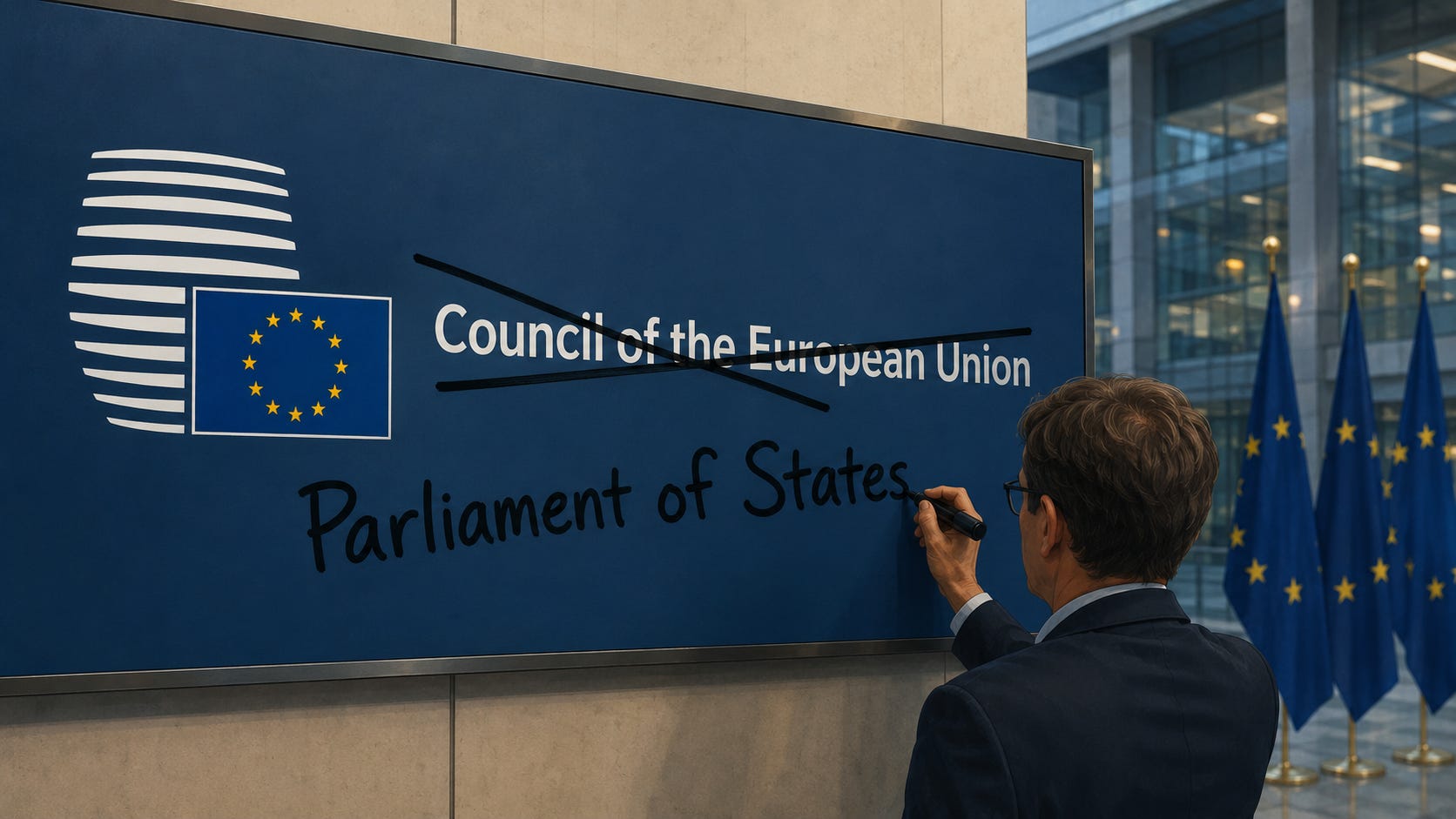
“The Council of the EU should be called the ‘Parliament of States,’ since the Parliament of Citizens is called the European Parliament,” Kahn argues. It is, as I explained above, a legislature. It consists of member state representatives (national ministers) who meet in various configurations (Foreign Affairs Council, Energy Council, Agriculture Council, etc) to craft legislation and vote on it by qualified majority. It adopts laws. But absurdly we’re not allowed to say this out loud, and we have to labour under the artifice that the Council is like the United Nations.
This not only confuses citizens, it also confuses the people who work at the Council – because member states still treat it as a foreign posting akin to delegations to the United Nations rather than a representative assembly. Each member state has a “permanent representation” headed over by a “permanent representative”. These are the infamous “EU diplomats” that you see quoted in news articles. They insist on journalists using this extremely misleading label in our articles for on background quotes because they don’t want it to sound like they’re part of a representative body. I refuse to use it, and I call them a “national representative” (I once got a complaint from a perm rep about this, I won’t name the country). An average person reading “EU diplomat” would assume you mean a diplomat representing the EU to another country - like the ones at EEAS missions around the world.
The reason these people insist on being called diplomats is because that is their background. The perm reps are all part of the member states’ foreign services. Before being posted to Brussels, a permanent representative might have been their country’s ambassador to Laos. The same goes for their perm rep staff – people from the foreign service who are rotated into Brussels on temporary postings (usually 2-3 years) in between postings at embassies around the world. This means the people working in the perm reps don’t treat the Council as a collaborative legislature but rather as an adversarial intergovernmental forum. And it creates perverse results.
As I wrote in 2021 for IP Quarterly: “The rot of EU dysfunction has one origin: the EU Council—the most powerful political institution in Europe unknown to most citizens. National governments like it that way, but democracy campaigners do not.” Former Dutch MEP Sophie in ’t Veld has also written about this in her book The Scent of Wild Animals, where she describes how the presumptions of the Council create bad and unaccountable policy.
In both of our books we call for treaty change to better define what the Council is. But in fact, a simple name change would go a long way toward fixing things. The Council is already a legislature, the problem is we don’t define it as such. Simply changing the name to “Parliament of States” and having countries separate the perm reps out from their foreign services would be a way to change the presumptions of how the Council is meant to work. It would also increase transparency by making it clear to citizens that the Council is a legislative body where their member state governments take decisions and can therefor be held accountable – just as Germans know how to hold their lander governments accountable when they take decisions in the Bundesrat.
Incidentally, the US Senate also used to function like the Bundesrat - with each state government appointing two senators to represent them in Congress’s upper house. But a century ago this was changed to having Senators be directly elected by citizens in those states, effectively duplicating the function of the House of Representatives. This was not how the US founding fathers intended the Congress to work. They intended it to work like Germany’s Bundesrat, or the EU’s Council.

EU Head of State and EU Head of Government
For 15 years we have been subjected to the continually embarrassing sight of the EU sending two presidents on international visits. That’s because the 2009 Lisbon Treaty split off the European Council of prime ministers from the EU Council of ministers (unnecessarily in my opinion), and created a permanent “President of the European Council” position. It replaced the previous rotating presidency in which a different prime minister chaired European Council summits every six months (a rotating presidency which still continues in the Council of the EU, more on that below).
At the time, there was an expectation that this person would serve as the “President of the EU” – finally answering Henry Kissinger’s famous question “who do I call when I want to speak to Europe”? But national leaders deliberately picked a low-profile coordinator type, former Belgian Prime Minister Herman Van Rompuy, as the first president in order to immediately dilute its importance and power. They didn't want anyone who might challenge their power and actually try to lead, such as Tony Blair who was being floated for the post at the time. They wanted someone who would simply chair meetings and try to find compromise between the leaders. The mild-mannered Van Rompuy, known for his compromise-finding role in fractious Belgian politics, fit the bill.
The problem was that the post had been set up with the pomp and importance assuming someone of higher stature. So the expectation was that this person would represent the EU at international fora such as the G20. Van Rompuy was not interested in doing this alone, so he did it jointly with the Commission President – José Manuel Barroso at the time. This was followed by the duo of Donald Tusk and Jean-Claude Juncker. On his way out the door in 2016, Juncker warned that while this had worked because the two men got along, the positions should be merged into one EU president because a future scenario where the two presidents didn’t get along would be disastrous. This proved prophetic, as the next duo Charles Michel and Ursula von der Leyen famously couldn’t stand each other. It was a power rivalry that culminated in the very embarrassing “sofagate” fiasco in Turkey in 2021.
I have argued in the past that the simplest solution to this awkward situation is to redefine the expectations of the newer role by changing the Council title to “Chairman” in English (this is, in fact, the word used for the title in Finnish media). In the EU we have a very confusing situation where each institution has a “president”, but it’s used in the French way (in addition to an executive post, it can also mean someone who presides over meetings) rather than the English (where it only has the executive function meaning). The President of the European Parliament would be better defined as a “Speaker of the Parliament”. I’ve written in the past that we should accept that the Commission President is the only EU President, and the Council has a chair who presides over summits but does not represent the EU internationally.

But Kahn suggests another solution. “The European Council is, in practice, a ‘collective head of state,’ like in Switzerland,” with its Federal Council, he writes. The Swiss Council has a “first among equals” president. But while this person represents Switzerland as the head of state and government (in tariff negotiations with Donald Trump, for instance), it is technically the Council itself that is the head of state and government.
Perhaps the best solution is to emulate the system that exists in many European countries, with the Council President acting as head of state with a ceremonial role, while the Commission President acts as the head of government with the actual leadership role. As in most European countries, it would be only the head of government representing the EU in international fora.
It’s not a perfect analogy. The EU setup is very different from both a unitary European state like Italy and a loose confederation like Switzerland (the EU is in many ways actually more centralised than Switzerland). While in Italy the President of the Republic is a mostly ceremonial position while the President of the Council (prime minister) is the actual leader, the European Council gives strategic direction and instructions to the European Commission. So a head of state European Council President wouldn’t be understood as a ceremonial role but rather an advisory or strategic role, in charge of conveying the consensus wishes of the national leaders to the EU head of government presiding over the Commission. This would better define and delineate what each person does. And that’s badly needed because right now the roles are overlapping and creating rivalries. It’s also creating a great deal of confusion for the public, who don’t understand why the EU has so many presidents.
High Representative of the Union for Foreign Affairs and Security Policy
Kahn criticises the deliberately confusing title given to the EU’s “foreign affairs chief” (the shorthand that journalists have taken to using). Under the EU constitution drafted in the early 2000s, the title was actually supposed to be “Union Minister for Foreign Affairs”. But after the constitution’s rejection by French and Dutch voters in 2005, they changed it to the long and disempowering title above in the Lisbon Treaty, one of several cosmetic changes made because European leaders concluded that voters had rejected the constitution because it had some symbols of a state. Despite the fact that, as I outline in The Owned Continent, there was no public polling evidence for this.
The person currently holding this unpronounceable position, former Estonian prime minister Kaja Kallas, is currently locked in a power battle both with President von der Leyen and national foreign ministers, who have been gleefully trashing her to any media outlet that will listen. She heads over a department that was also deliberately given an unpronounceable name, the European External Action Service (EEAS). Recent leaks against her that likely came from the 13th floor of the Berlaymont have just highlighted how impossible this job has become because it was been undermined from the moment it was created in 2009. Just like with the Council President position, national leaders deliberately chose a low-profile person with no foreign policy experience, Catherine Ashton, to be the first holder of the post in order to quickly defang it.

It’s the constant story of the EU: national leaders know that the EU needs to be united so they agree to a treaty creating a position giving the EU a single foreign policy voice. But then they immediately undermine it by giving it an absurd title and sidelining the person from day one. National leaders know what needs to be done to make Europe strong, but as soon as they do it their short-term-thinking instincts kick in and they undo it.
In order to clearly define the position and give it actual power, the title should be changed to “Union Minister for Foreign Affairs” as envisioned by the constitution and the EEAS should be renamed the European Foreign Service.
EU Commissioner for Democracy and Demography
Kallas sits both within the Council and the Commission - occupying Estonia’s seat in the 27-member college of commissioners. So while we’re at it, let’s knock it off with the absurd and confusing titles given to the other commissioners as well. Here I’m going beyond Kahn’s recommendations and adding one of my own.
All commissioners, not just the HRVP, should no longer be given these purposefully misleading and disempowering titles like “Vice President for the Clean, Just and Competitive Transition” and instead have normal titles that actually indicate what they do and correspond to national minister roles. I.E., Trade Commissioner, Competition Commissioner, Justice Commissioner, Home Affairs Commissioner, Energy Commissioner, etc.
Part of the reason for these stupid titles is that we’ve been stuck with an unwieldy commission college size of 27 people thanks to the initial Irish ‘no’ vote to the Lisbon Treaty in 2008. Originally the treaty had kept the constitution’s restructuring of the Commission to get rid of the ‘one commissioner per country’ system and instead have smaller member states like Ireland sometimes have one and sometimes not. The Commission is, after all, not meant to be a representative body and the commissioners are not supposed to be representing their home country. They’re supposed to be politically and geographically independent, so there’s no reason for each member state to have someone in the college. But keeping the ‘one commissioner per country’ system was a concession offered to the Irish voters to have them approve the treaty when they voted again in 2009. I doubt that most voters even got the memo - the treaty was approved the second time because the government actually put effort into campaigning for it.

So now we have to invent titles for all 27 of these people, and some of them are ridiculous. Past titles have included “Commissioner for Promoting our European Way of Life”, “Commissioner for Multilingualism”, “Commissioner for Democracy and Demography” and “Vice President for Better Regulation, Interinstitutional Relations, the Rule of Law and the Charter of Fundamental Rights”.
Few national governments would have 27 equally-ranked ministers. What you usually have are the main senior ministers (sometimes called Secretaries of State) and then junior or deputy ministers. But because of the sensitivities of having one country’s commissioner designated as a junior or deputy, a senior team of ‘vice presidents’ has been invented (designed more to assuage national egos than to recognise the competence of the people involved) who have several commissioners vaguely serving under them but not clearly defined as such. It’s a mess.
It’s time to end this absurdity. Have normal titles that mirror what exists at national level, and then assign other commissioners as their deputies as exists in national systems.
The rotating EU presidency
Another extra one from me: We need to end the confusing and expensive practice of the country-based Rotating Presidency of the Council of the EU and instead have the corresponding commissioner chair the ministerial councils. So the EU Energy Commissioner would chair the energy ministers’ council meetings, for example.
I know people will object to this because it would blend the roles of theoretically ‘competing’ institutions. But why shouldn’t the person who crafted the law chair the discussions about it? The chairmanship doesn’t actually give them any power in the voting process, the decision is still for the governments to take. I understand the European Parliament might object to this as well because it makes it look like the Commission and Council are ‘on the same side’ working against them in the legislative process. So another solution might be appointing a permanent chair from among the national ministers for each Council configuration, as is already done for the Eurogroup.
The rotating presidency is confusing for citizens as it gives them the impression that the prime minister of that country is “President of the EU” for six months, which is not even remotely true. The country is just chairing discussions in one specific EU legislative institution. The prime minister who sits in the European Council actually has no formal role in the rotating presidency because the EC has a permanent president. This has particularly become a problem when countries like Orban’s Hungary take over the rotating presidency.
A big part of the reason why the EU seems so distant and aloof from citizens is that European leaders have deliberately tried to confuse their citizens about what the EU is. Consciously or not, these absurd or misleading titles and institutional names have been a part of that effort. If we want a union that is understood and supported by citizens, then we need to be honest about what this union is. It is currently a supranational confederation, which already has many of the hallmarks of a federal state. Whether or not you want it to become a full federation as I do, you cannot deny the current reality just because it makes you uncomfortable to call the EU a state. We will never achieve European sovereignty if we continue labouring under the artifice that the EU is a “UN for Europe”.
The EU is not a nation-state. But it is a state.

As for the rotating presidency, it might be expensive but in some ways it’s the EU’s equivalent of a royal progress. A common failure mode with political unions is that one member starts engaging in corrupt or sectarian behaviour and the rest of the union has to carry the cost (US Deep South, Northern Ireland, Hungary). Every state will be on the stage every 20 years or so reduces the odds of this happening.
To illustrate my point, imagine if British ministers had to spend 6 months in Wales Scotland, and NI every 20 years, it would be good for the UK.
The Irish veto on losing our commissioner was based on experiences during the Union with Britain where you had an entirely non-Irish cabinet incompetently and arrogantly making policy for Ireland based on racial prejudice. The country will likely never give it up, for good reason.