On Thursday night, at the June European Council summit, EU prime ministers and presidents discussed whether they should switch to a tougher strategy on EU-China relations. Frustrations with China dumping exports into the EU market (while not allowing EU companies access to the Chinese market) have reached boiling point. Even Bejing’s biggest European trade partner Germany is ready to do something about it (or at least, that’s what Chancellor Olaf Scholz is saying publicly).
But not everyone is in agreement. While France (backed by Italy) is pushing for a tougher line, Germany has been more reticent while Spain has questioned the wisdom of starting a trade war with China just as Europe is being abandoned (and threatened) by its longtime ally the United States. On Thursday morning I published a long read about the history of EU-China relations and how for so long it has been dictated by the United States (something particularly evident during the Biden administration when the US State department exerted huge pressure on Europe to fall in line).
Finbarr Bermingham, Chief Europe Correspondent for the Hong Kong English-language daily South China Morning Post, pointed out that while this may have been true in the past, the Trump administration’s incoherent policy toward China means that Washington isn’t doing much to dictate the EU’s China policy these days. The current dynamics, he says, don’t have much to do with transatlantic relations. That may be true, but should it be? I wonder what the Trump administration would do if they noticed the EU taking a softer (or at least, a more hedging) approach toward China. I imagine they would suddenly become more interested.
So, I thought it would be interesting to talk with Finbarr after the Council ended Friday evening about the outcome of the China dinner and what might come next.
Why is von der Leyen still letting the US dictate EU-China policy?

Over dinner in Brussels tonight, EU national leaders will discuss the Commission president's push for a crackdown on trade relations with China – exactly what Washington wants.
The dinner was rather inconclusive (though EU diplomats had done everything possible to lower our expectations during their briefings ahead of the summit), leading various media outlets to lead with contradictory takes. Spanish newspapers concluded that Sanchez had been successful in putting the brakes on a trade war with China. The Financial Times led with something similar. Reuters noted that it’s still unclear whether the new toolbox of possible retaliatory measures which countries have tasked EU Commission President Ursula von der Leyen to come out with (probably in September) will have teeth. Politico, however, predicted that Thursday night’s instructions will lead to a major trade confrontation with Beijing. Others prematurely predicted a law ordering European companies to diversify their supply chains away from China (possible but unlikely that we’ll see such a proposal in September).
The discussion, held in top-secret format with no phones in the room, did not yield specific Council conclusions that named China. They simply said “global macroeconomic imbalances require a European response based on two pillars: European unity and dialogue with our principal economic partners.” President Macron won language that states the EU should consider to “develop and, eventually, expand the set of instruments in the area of trade defence and industrial policy, to ensure that the European Union has all the tools necessary to defend its interests and reduce risks.” But Sanchez won language that states this “European response” will be built by “maintaining a constructive dialogue with our principal economic partners in order to defend our economic and security interests.” The EU must be “reducing risks, decreasing its dependencies, and strengthening its strategic autonomy.”
Arriving at the summit on Thursday, Pedro Sanchez cautioned against making an enemy of Beijing (given the threats that are coming from Washington). “What Europe needs are friends,” he said, calling China a “potential new ally”.
This is the crux of the debate. President von der Leyen has been insisting for years that the EU’s strategy toward China should be “de-risking, not decoupling”. But when asked last year whether the EU should also have a de-risking strategy when it comes to the US, the EU president reacted as if the question was absurd, saying the answer is a “clear no”. “It’s a completely different relationship with the United States than we have with China.”
And so when President von der Leyen took to the podium after the summit ended on Friday insisting that “Europe must avoid dependencies that can be weaponised,” it was hard to take her seriously when she will only name the Russian and Chinese dependencies but refuses to put in the same category the country on which the EU has much more dependence. The country that is currently weaponising those dependencies in the most dangerous way. For her, America is still the dependence that dare not speak its name.
This is not to dismiss the danger of Europe’s growing economic dependence on China. As Finbarr pointed out during our chat, it is a real problem. China’s overproduction and Europe’s trade deficit are not sustainable and threaten EU industry. The EU’s trade deficit with China reached €360 billion in 2025. In the first quarter of 2026, the deficit continued to widen to nearly €95 billion, whereas in the same period of the previous year it had reached €88.4 billion.
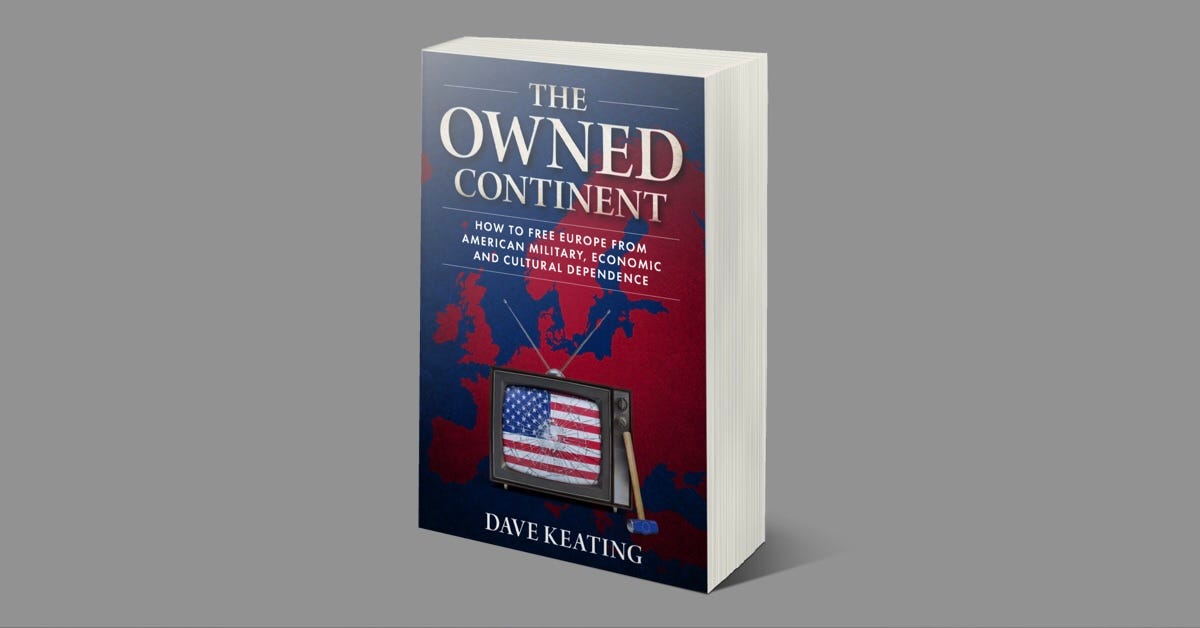
And yet, there aren’t Chinese troops occupying EU territory. China doesn’t have bases on which Europeans depend for their defence. Europe’s economy doesn’t rely on a bedrock of Chinese economic infrastructure. We’re not storing our data on Chinese clouds. Our TVs and radios are dominated by Chinese shows and songs. In this context, talking about the Chinese dependence threat as if it is more of a risk than the American dependence threat is absurd.
It’s a growing problem, yes. But it has to be seen in the context of the fully matured American problem. And that is what Sanchez, backed by Greece’s conservative prime minister Kyriakos Mitsotakis, is calling for.