
Can Burnham avoid the Trump trap that ensnared his predecessor?
Starmer's grovelling to the US president did not spare Britain from Trump's attacks. But as the new UK prime minister takes office today, he's hamstrung by the same "special relationship" albatross.

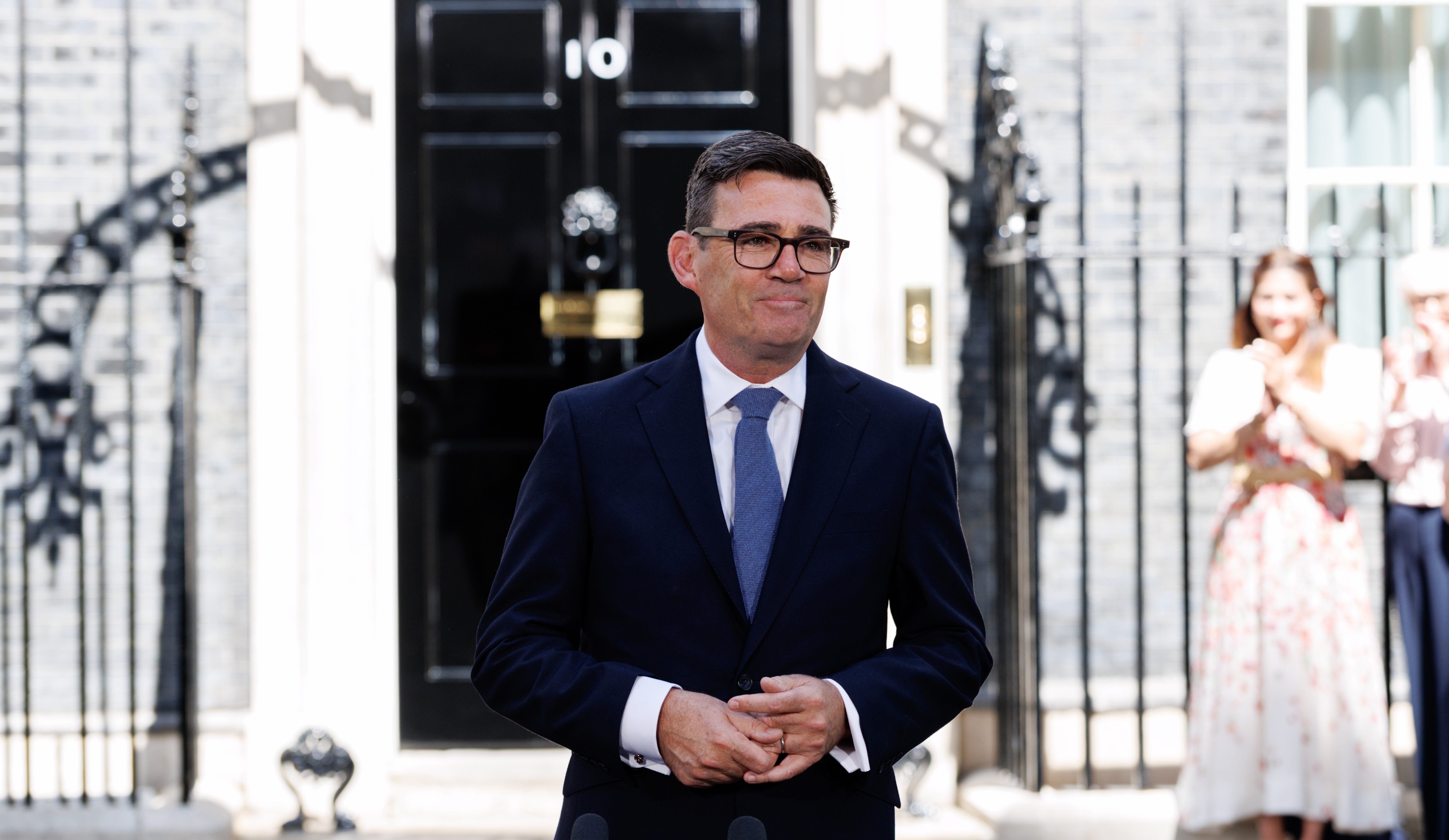
In February 2025, the British media were obsessed with the upcoming first meeting between Keir Starmer and Donald Trump, who had just started his second term. The visit had to go perfectly, they opined, in order to avoid the US president’s wrath. Starmer dutifully showed up with gifts and over-the-top flattery in hand. It seemed for a moment that he had bought Trump’s affection - trading dignity for momentary safety. The British media gushed over Starmer’s grand success. The Daily Mirror called the prime minister "Charmer Starmer" and the Independent called the meeting a "diplomatic win". The Sun called it a "love-in", while the Daily Mail said Trump and Starmer had "struck up an unlikely bromance" which could "forge a fruitful partnership.”
The prime minister seemed to get caught up in that praise, as the British media gushed over Trump’s patronising compliments. All Trump had to say were the words “special relationship” and the UK press was eating out of his hand. “What a beautiful accent” Trump said of Starmer’s voice, calling him a “tough negotiator” and saying the UK is a great country. He said Starmer had tried his best to convince him not to tariff the UK, and Starmer grinned like a schoolboy who got a good review on his homework. But even though Starmer gave away his ace card - an unprecedented invitation from King Charles for a second state visit to the UK - he got absolutely nothing in return. You wouldn’t have been able to tell it from the exuberant UK press coverage, but when Starmer left Washington the situation was completely unchanged. Trump had not given any reassurances on security guarantees for Ukraine or on not launching a trade war against the UK. Just says later, Trump attacked President Zelenskyy in that same oval office. Months later, he started attacking Starmer on a number of fronts. And in June, Trump delivered the most personally humiliating blow - prematurely celebrating Starmer’s resignation from office.
“Keir Starmer, Mr. Burnham’s predecessor, famously fawned over the American president in early 2025, hoping to avoid the consequences of Mr. Trump’s angry outbursts,” observed the New York Times today. “Many Britons still remember the image of Mr. Starmer, bending down to pick up papers that the president had dropped at a G7 summit. Stroking Mr. Trump’s ego only goes so far, and the president eventually imposed tariffs on Britain anyway. And when Mr. Starmer refused the president’s request to use British bases to launch attacks at the start of the U.S.-Israeli war with Iran, Mr. Trump lashed out repeatedly at Mr. Starmer, calling him weak and a coward.”
This week we learned how badly Europeans want to be fooled

UK media were easily bought off with cheap flattery on Thursday, heralding Starmer's Trump visit as a grand success. Continental reactions to Macron's Monday visit were similar. Then came Friday.
As Andy Burnham takes over today as the UK’s seventh prime minister in a decade, the British media are again fretting over how his personal relationship with Trump will impact the “special relationship”. They aren’t calling for the new leader to stand up to Trump and protect the country’s and Europe’s interests. Once again, the default expectation seems to be that he should grovel.
Burnham and Trump have never met, and the US president doesn’t seem to know anything about him. “I see that he was, I guess, the mayor of a town,” Mr. Trump told reporters earlier this month. “I hear he’s extremely liberal, extremely. So that means he probably won’t open up the North Sea” to allow more drilling for oil and gas, he said. But this in fact is expected to be one of Burnham’s first announcements.
So far, Burnham has seemed keen to avoid the topic. He has said his first phone call after taking office will be to Trump, as is expected of a British prime minister. But he doesn’t seem to be in any hurry to rush to Washington for a first visit - as Keir Starmer was in a hurry to do last year. In an interview with former footballer Gary Lineker last week, he was keen to downplay the difficulty of dealing with the US president. “It’s about being yourself, isn’t it?” he said. “I like to think I’ve got some personality myself, and I’ll deal with him very upfront in the same way,” he said, clearly implying that his predecessor did not have some personality. “It’s about respecting the office, the relationship, the U.K.-U.S. relationship. Where you disagree, do it. But do it in a way that is kind of meeting him where he’s at.”
For those who want the new UK leader to abandon Starmer’s failed appeasement strategy and take a page from Spain’s Pedor Sanchez or Italy’s Giorgia Meloni, that last sentence will be disappointing. What is “meeting him where he’s at”?

Ahead of Burnham taking office today, Donald Trump called the UK a “poverty stricken disaster” this weekend. And Burnham, in his previous role as Mayor of Manchester (or ‘some town’ to Americans) was willing to make some light criticism of the US president. But once he started his machinations to oust Prime Minister Starmer, he suddenly became very quiet on the subject. In his first substantive foreign-policy statement after taking over as leader of the Labour party a few weeks ago, published in The Times, he clearly signalled that his preference is to get “even closer” with the EU rather than chasing after the special relationship with the US. But he’s still using very soft coded language to say it.
What matters is whether Burnham is willing to spend actual political capital picking a fight with the world’s most powerful man as Meloni and Sanchez have done. And on that, he now has two live case studies sitting right here on his continent.
The Sánchez model: pick the fight, mean it, absorb the cost
Pedro Sánchez has become the closest thing Europe has to a Trump-proof politician, and he built that reputation the hard way. He refused to let the US use Spanish air bases or airspace for operations against Iran, pulled Spain’s ambassador from Israel, and was the only European leader to immediately speak out against the Venezuela and Iran invasions. Trump responded by threatening to cut off all trade with Spain and calling it a “terrible partner” at the NATO summit in Ankara this summer. Trump has attacked Sanchez repeatedly, including in front of the German chancellor who predictably declined to show European solidarity with his Spanish counterpart.
Sánchez’s answer was to insist relations were still “positive” while conceding nothing on substance. He also leaned on Brussels for cover, and got it – the European Commission has publicly committed to shielding Madrid from any US tariff retaliation (because you cannot cut off trade with just one EU member state, the EU is one country for the purposes of trade). That’s the Sánchez playbook: defy Washington on the thing that matters to your voters, don’t grovel afterwards, and make sure the EU has your back before you do it.

The Meloni model: a reluctant convert dragged there by ego, not ideology
Giorgia Meloni’s journey is the more interesting one, because nobody saw it coming. She was the Trump whisperer, the only European leader at his inauguration, the one Brussels assumed would always find a way to soften the transatlantic blows for the rest of the union. Then Trump attacked the pope and publicly claimed she’d “begged” him for a photo at the G7, and something snapped. Meloni hit back on Instagram, dismissing the claim as invented and pointedly noting that her popularity had never depended on her friendship with him but in fact suffered because of it.
Trump escalated with a meme suggesting he needed a restraining order against her because she’s obsessed with him. Since then she’s held her line on not joining strikes against Iran, and Italy’s foreign minister cancelled a trip to Washington entirely. What’s notable is that this wasn’t ideological conviction pulling Meloni away from Trump – it was wounded pride and a shrewd read of where Italian public opinion was heading with an election on the horizon. But the effect is the same: a far-right European leader who was supposed to be Washington’s inside voice in the room has instead been pushed toward Paris, Brussels and her own version of dignity. It is part of a larger trend of the European far right not only backing away from Trump but being much more vocal in their criticism of his imperial wars than Europe’s centrist leaders.
So which one is Burnham?
Burnham enters office with none of Sánchez’s structural advantages – Spain has the EU’s single market and Brussels’ tariff shield behind it. Britain, post-Brexit, has neither. If Trump decides to make an example of the UK the way he did with Switzerland, Burnham can’t hide behind EU solidarity. That is the uncomfortable arithmetic nobody in Westminster likes to say out loud: talking tough on Trump is a lot easier when you have twenty-six friends standing next to you at the table.
What Burnham does have is the rhetorical instinct of Meloni’s recent conversion: the sense that being seen to stand up to Trump is now good domestic politics, not just principled foreign policy. That’s important in a country where the far-right party Reform UK is simultaneously trying to out-flank Labour from the populist right while quietly admiring Trump from across the Atlantic. Burnham’s team clearly understands that appeasement bought Starmer nothing but insults. The tricky part is that being rhetorically tough is the easy 20%. The hard 80% – the Sánchez part – is being willing to actually lose something: a trade deal, a defence commitment, an intelligence-sharing understanding, and eating the political cost of it rather than folding at the first tariff threat.
Can Europe regain cognitive sovereignty?

America doesn't only occupy Europe militarily and economically. When we say we want strategic autonomy, we should also be thinking about how to liberate the European mind.